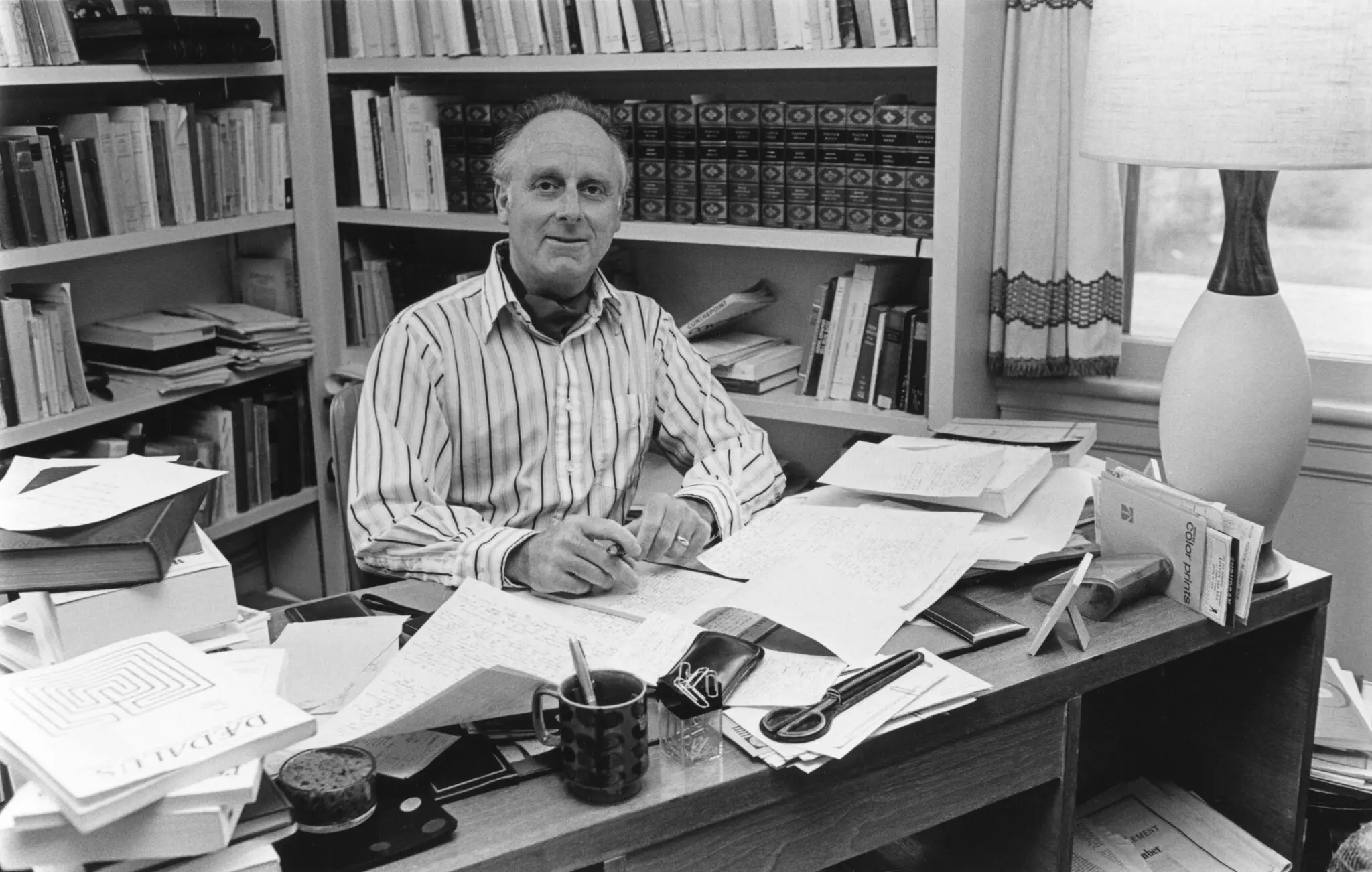
The photograph above features Victor Brombert, a professor of comparative literature at Princeton, who rates an obituary in the NYT not because of his academic career but because of what he did during the Second World War.
His personal story is a great one, but I like this photo as an exercise in the archeology of what Shannon Mattern calls “intellectual furnishings.” What might have been on a literature professor’s desk in 1985? In this case:
- Books
- Academic journals
- Pen
- Pencil (I think that’s a pencil he’s holding, but it’s really thick — maybe some kind of editorial pencil?)
- Coffee mug serving as pen/pencil holder
- Ink blotter
- Home-style lamp
- Small Rolodex (or other brand) to hold cards with addresses
- Daily calendar (that’s the thing with the little stand on the back, next to the Rolodex: it shows what day it is and when you come in the next morning you tear off Yesterday and throw it away, revealing Today)
- Sponge for wetting postage stamps
- Paperweights (at least two)
- Magnetic box for holding paperclips
- Mail (under the scissors-paperweight)
- Envelope containing photographic prints, probably picked up from a drugstore on Nassau Street
- Small personal notebook (under a sheet of paper next to the coffee mug)
- A loop handle (next to his right forearm), presumably attached to something — a small instant camera, perhaps? The camera with which he took the snapshots he had developed at the bookstore?
What’s absent? There’s no computer — there’s not even a typewriter, though there may be one elsewhere in the room. It’s possible, though, that Brombert had a secretary to type up, when necessary, his handwritten texts. I mean, the guy is wearing an ascot, and it is a truth universally acknowledged that men who wear ascots do not do their own typing.
