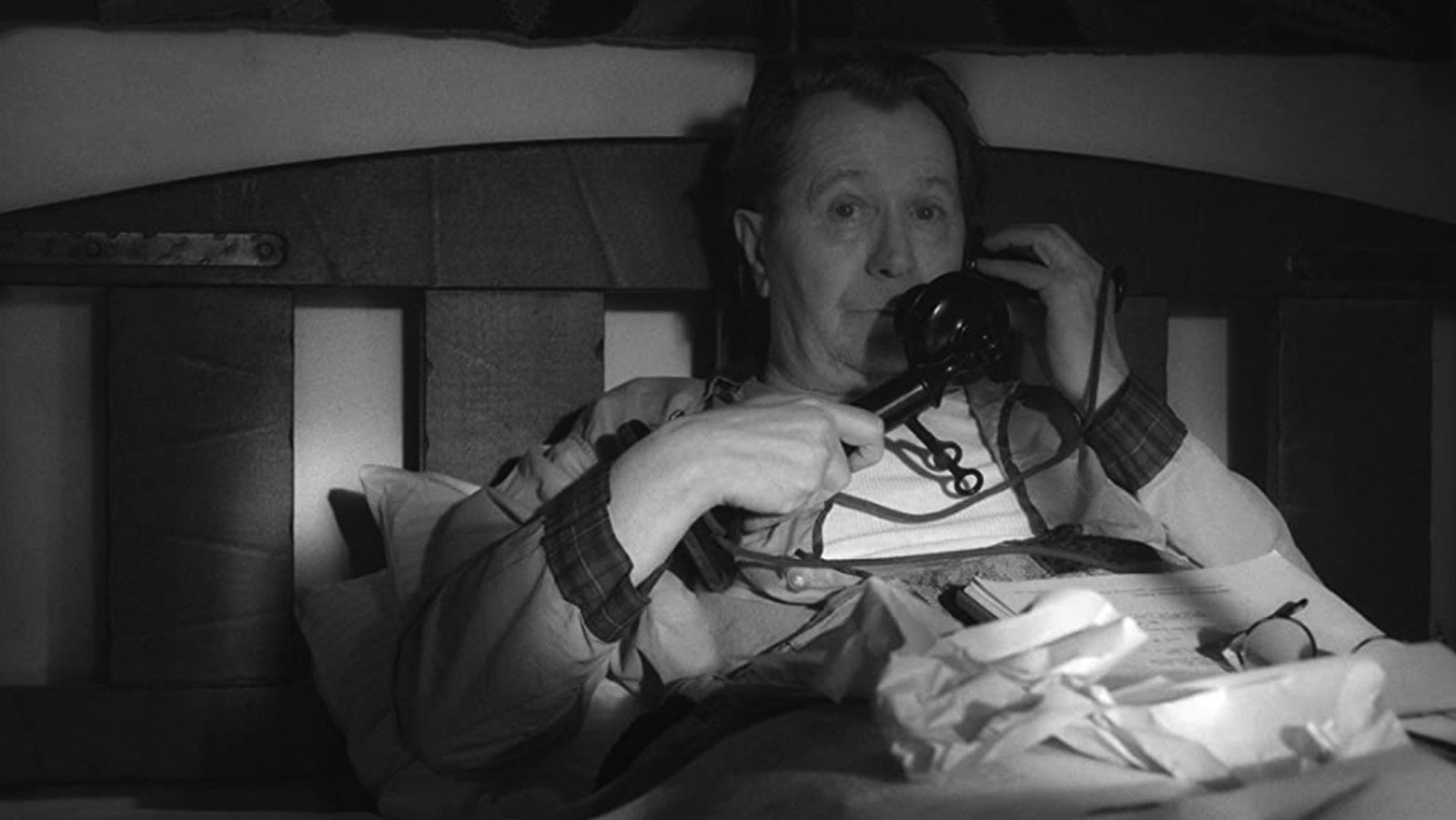
In David Fincher’s Mank (2020), Herman J. Mankiewicz, laid up with a badly broken leg and confined to a cabin in the Mojave Desert, writes the screenplay for Citizen Kane. His only companions are a German woman who serves as his housekeeper and physical therapist and an an English woman who types up his handwriting. Occasionally John Houseman drops by to wring his hands over Mank’s lack of progress. Orson Welles shows up once.
Mank is a wonderful movie, but this is not at all what happened. The movie’s screenwriter, Jack Fincher – David Fincher’s father – uncritically accepted Pauline Kael’s claim that Mank wrote the whole screenplay and that Welles, in putting his name in the credits as co-writer, stole Mank’s thunder. The Finchers would also have us believe that Mankiewicz was a man of impeccable leftist credentials, whose dislike of William Randolph Hearst was rooted in Hearst’s support (in the 1934 California gubernatorial race) for the Republican Frank Merrian, who won against the Democratic candidate, the novelist and social critic Upton Sinclair. But, again: It wasn’t like that. Mank is a wonderful film, but it’s almost wholly fiction.
(Kael’s essay on Kane is the single most famous thing she ever wrote, but it is so manifestly and demonstrably wrong about Welles’s role in the screenplay that — as I noted a few years ago — that essay is silently omitted from the Library of America edition of Kael’s writings.)
As Simon Callow points out in his brilliant biography of Welles, Mank was “without peer as a screenplay doctor,” but “had more difficulty initiating work.” When Welles approached him to work on a screenplay – topic yet to be determined – Mank agreed only on the condition that John Houseman be brought in as his collaborator. Welles, though he had just had an overturned-tables-and-flung-tableware falling-out with Houseman, immediately agreed. The three of them met several times in Hollywood to thrash out the basic framework of the story.
Then, when Mank was sent to Victorville in the Mojave Desert to write the screenplay, Houseman accompanied him. Houseman was no occasional chastising visitor, he was a constant presence, working through possibilities with Mank and only when a direction was established leaving the screenwriter alone to work.
Moreover, Welles was not wholly absent – as in the movie, when he just calls on the phone a couple of times before a dramatic confrontation with Mank when the screenplay is already done – but rather came to Victorville himself on several occasions. When he wasn’t there, drafts were sent to him in Hollywood, to which he responded with praise, criticisms, and suggestions.
No one ever suggests that Houseman should have received a screenwriting credit for Citizen Kane, but he probably should have. But in any case, the screenplay was not Mank’s own but the product of collaboration, especially with Welles, with whom Mank constantly struggled for control over the story. In what Callow rightly says is “one of the most pertinent observations about Citizen Kane,” Welles later remarked that one of the key features of the movie is a “certain tension” in the portrayal of Kane: “One of the authors hated Kane and one of them loved him.”
And one more thing: While Mank may have been an impeccable leftist in 1934, by the time he co-wrote Kane he had moved considerably to the right, and towards isolationism. Moreover, as Callow notes, he came to believe, though a Jew himself, that “the Nazis were right about the over-dominance of the Jews” in Germany – even as he paid to sponsor Jewish emigres from Germany to the U.S. The movie tells us about the sponsorship but not about the agreement with the Nazis.
The real Mank was phenomenally gifted, but was a different kind of person, and a different kind of writer, than Fincher’s excellent movie suggests. I doubt that a movie about the real Mank would ever have been made.

Sources:
- Simon Callow, Orson Welles: The Road to Xanadu
- David Thomson, Rosebud: The Story of Orson Welles
- Robert Carringer, The Making of Citizen Kane, Revised Edition
