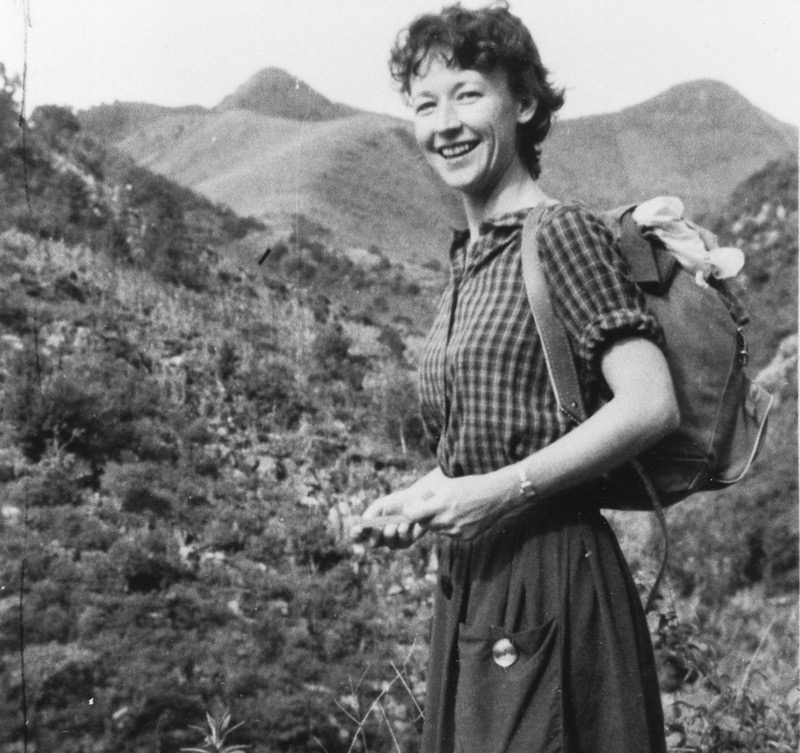
That is Vida Chenoweth; the picture was taken when she was in the second of her three careers.
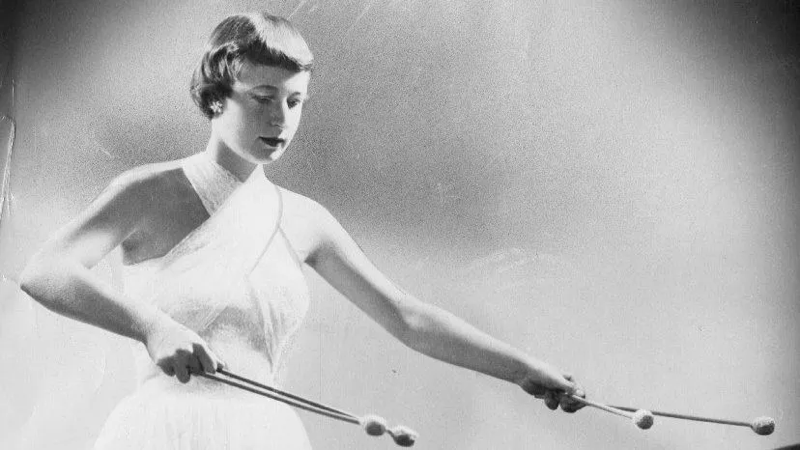
Her first career: pioneer of the marimba as an instrument for classical music. Chenoweth may have been the first person to play the marimba in concert at Carnegie Hall, in 1959, when she performed the world premiere of Robert Kurka’s Concerto for Marimba. (Kurka was a highly promising composer who had died two years earlier, of leukemia, at the age of 39.) Reviewing the performance for the New York Herald Tribune, Jay S. Harrison wrote,
Mr. Kurka located innumerable means of displaying the marimba at its best, and his concerto is everywhere lively and zestful. It is mostly diatonic, filled with smart and leaping tunes, and it exploits the agility of its soloist to the utmost. Fortunately, Miss Chenoweth is a real-life virtuoso who, no matter what the demands made on her, missed not a note and managed, further, to wring every possible shade of sonority from the wooden keys laid out before her. There was exhausting bravura to her work and genuine musicality as well. It was a star performance and a bewitching one — no question of that.
There is some uncertainty about what led Chenoweth to abandon the concert hall. We know that her hands and arms were badly burned when a gas oven in her home exploded, and that doctors at first thought that several of her fingers would have to be amputated; this is often cited as the reason for her retirement. But in a 1990 interview with the Chicago Tribune she said that she had already decided that she didn’t enjoy fame; and in any case, her arms and hands fully healed, in a way that she believed to be miraculous. (She occasionally performed in later years.)
It seems to have been when she returned to her native Oklahoma to heal from her injuries that she discovered the work of Wycliffe Bible Translators, and decided that God was calling her to that work. She moved to Papua New Guinea and lived among the Usarufa people, eventually (working with a colleague) translating the New Testament into Usarufa. Thus her second career.
Her experiences among the Usarufa led her to another realization: that Christian missionaries, focused as they were on making the Bible known to the peoples of the world, had neglected the essential role that music plays in cultural formation and expression: while translating the Bible into strange tongues, they would teach the people who spoke those languages hymns written in European musical forms. Chenoweth came to believe that this was both a missed opportunity and an insult to the people whom the missionaries were trying to reach: they should be encouraged to make their own hymns in their own musical vocabularies. She became ever more fascinated with these matters, and moved to New Zealand to study ethnomusicology at the University of Auckland, where she took a PhD in 1974.
This led to her third career, as a professor of ethnomusicology. She became a permanent faculty member at Wheaton College in Illinois in 1979 — five years before I arrived there — and for the next fourteen years not only taught ethnomusicology to students in Wheaton’s Conservatory of Music but also took them on long overseas excursions to a wide range of places around the world, including Senegal, Cameroon, the Solomon Islands, Peru, Indonesia, and her former home Papua New Guinea.
During these excursions she made extensive field recordings which, on her retirement, she carefully annotated and then donated to the Library of Congress. Here’s the official description of the collection:
Collection of papers and audiovisual materials representing the life work of ethnomusicologist Vida Chenoweth. Manuscripts, sound recordings, photographs, and films mainly of her work with the Usarufa and numerous other people in Papua New Guinea, but culture groups from other places are also represented, including Vanuatu, Indonesia, Solomon Islands, Cook Islands New Zealand, Kenya, Zaire, Ethiopia, Madagascar, Ivory Coast, Ghana, South Africa, Cameroon, Senegal, Nigeria, Sierra Leone, Mali, Cameroon, Vietnam, Thailand, Laos, Cambodia, Mexico, Guatemala, Panama, Ecuador, Brazil, Peru, and the United States. Includes work done by her students at Wheaton College and colleagues at the Summer Institute of Linguistics. Includes recording logs, analysis, song transcriptions, song texts, theses, correspondence, Chenoweth’s diaries (1980s), and field notes. Sound recordings include music and spoken word from various provinces in Papua New Guinea, such as Eastern and Western Highlands, Madang, Morobe, East New Britain, New Ireland, and Irian Jaya provinces. Moving images include Chenoweth family films, as well as documentation about music and practices from throughout Papua New Guinea, the Cook Islands, Vanuatu, and other regions. They also include content from the South Pacific Festival of the Arts in Port Moresby, Papua New Guinea.
What an astonishing person, and what a life. Vida Chenoweth died in her home town of Enid, Oklahoma in 2018, at the age of 90. I am proud to have known her, if only to say hello to, and to have been her colleague.

