
It’s clear that the people who did the marketing for Cat People (1942) didn’t know what happens in the movie — or maybe just didn’t understand it. They made Simone Simon look sultry and dangerous:

But in the movie mainly she looks like this:
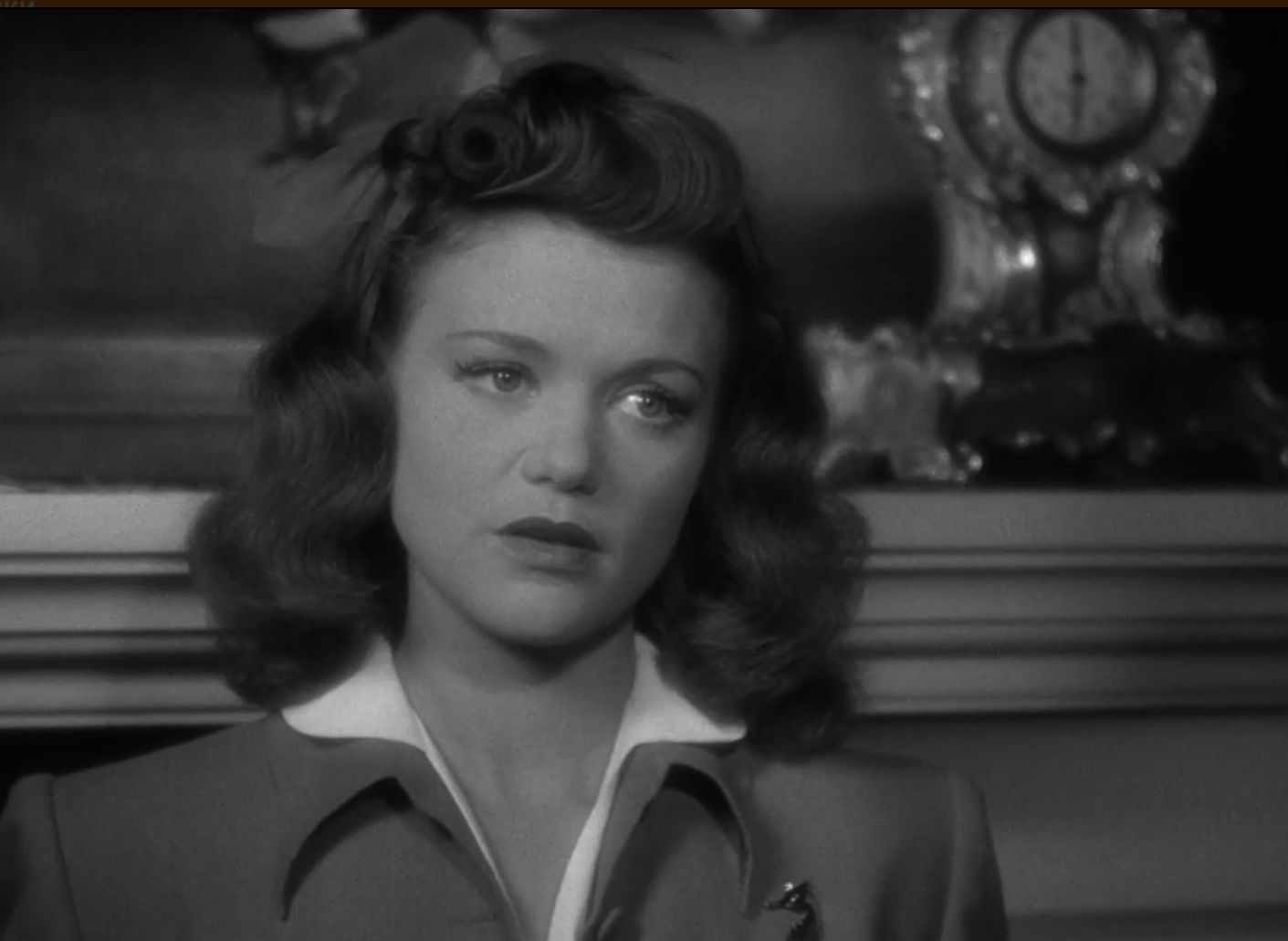
A neatly, modestly dressed young lady who is slightly worried — worried that if she is sexually aroused she will turn into a black panther and kill the man who wants to be intimate with her. (This is explained, sort of, by her being descended from Serbian cat people. At one point in the movie a very catlike woman addresses her, in Serbian, as moja sestra — “my sister.”)
All this is usually seen, by nod-nod-wink-wink viewers and critics, as an allegory for the fear of sex. But it’s a little more complicated than that. Three times in the film we see — well, actually we don’t see anything: this is a Val Lewton film, and the guiding principle of Lewton’s horror films is that you’re more afraid of what you imagine than what you directly perceive.
So: three times in the film Irena turns into a panther. (Maybe four, but it would be a total spoiler to get into that question.) The first one happens when she comes to suspect that her husband — whom she will not have sex with or even kiss: their physical relationship seems to max out at sitting next to each other at a restaurant — is growing close to Alice, a woman he works with, sometimes late into the evening. Her suspicions, not incidentally, are justified. Once Irena follows Alice along a dark city street, the women’s heels clicking on the sidewalk … but then the clicking of Irena’s heels stops, after which slight rustling sounds are heard in nearby overhanging bushes. (The sound design here is terrific, and the scene ends with what may well be the very first jump scare in movie history.)
Later, Irena follows Alice into a Y.W.C.A, where Alice regularly swims. Here’s a clip — in which, by the way, we see Jane Randolph’s Alice in a wet swimsuit, in contrast to Irena’s consistently buttoned-up style. (The movie thus sexualizes Alice and desexualizes Irena, which is just what the marketing people couldn’t understand. They obviously figured that Irena was catlike in a sexually predatory sense.) When Alice hears strange sounds around her, she leaps into the pool to get away, is eventually confronted by human-Irena, and when she emerges, discovers that her robe has been torn to shreds by something with claws.
The third transformation is the most interesting one. Irena has agreed to see a psychiatrist, who tells her that her fear is irrational — and then seeks to prove it by seducing her. He kisses her, and then … well, let’s just say that wasn’t his best play. But the key point, it seems to me, is that she is obviously not aroused, nor interested, nor even pleased. See for yourself.
So: while the general context of Irena’s transformations is the realm of sex, she never transforms because she experiences sexual desire, but rather because she experiences jealousy and anger. That is to say, Irena’s problem is not sexual passion but rather passion more generally: unbridled emotion, emotion that we suffer (Latin passio, yielding the English “passive”) rather than control. This I find curious, and I suspect that the Hays Code was responsible for this generalization — a generalization amounting to misdirection. Perhaps the filmmakers didn’t dare show Irena being turned on by her husband and having to struggle against it, and aroused by the kiss of her suave psychiatrist. Or were they trying to show a character so deeply sexually repressed that her sexuality could emerge only through other emotions? If the latter, then maybe the Hays Code actually worked in their favor.
One last point, on a related matter. In the Lewton horror films of the Forties, there are several characters like Irena: let’s call this type the Unsuitable Wife, the woman who blocks the male lead from marrying the Normal Woman he loves and is obviously meant for. Oliver can’t marry sexy Alice as long as sexless Irena is in the way. (The locus classicus for this theme is obviously Jane Eyre.)
A different version of the same problem appears in I Walked with a Zombie (1943): poor Paul is clearly attracted to his wife’s nurse, but how to get rid of the wife? She’s a zombie, after all. Can’t have sex, or even companionship, with a zombie, and murdering her would be complicated — as well as immoral, of course. Jessica is not a zombie in the George Romero sense, but nevertheless is locked away in her own wing of a compound, sort of like Ed at the end of Shaun Of The Dead but not as much fun.

And in The Seventh Victim (also 1943 — Lewton’s studio worked fast) poor Gregory is married to a Satanist when the woman he really loves is the Satanist’s cute kid sister. About that … I don’t mean to be judgmental, but if you marry a woman without knowing that she worships the Devil then maybe your engagement wasn’t long enough.

In each case we’re encouraged to think: Ah, wouldn’t it be great if the Unsuitable Wife died and left the guy free to marry the Normal Woman and get it on with her? And in each case we get what we wish for. Call it the Hollywood version of no-fault divorce.
