I’ve read several detective novels by Freeman Wills Crofts, and my one most constant thought is: He is an utterly inept writer. His style only occasionally rises to the level of woodenness, and is usually sub-wooden. Like charcoal, maybe: dry and brittle, no longer alive, an ex-style.
Here’s a typical passage, from Antidote to Venom (1936):
His thoughts swung round into a familiar channel. If only his old aunt would die and leave him her money! She was well-to do, was Miss Lucy Pentland, not exactly wealthy, but obviously with a comfortable little fortune enough, and she had on more than one occasion told him that he would be her heir. Moreover, she was in poor health. In the nature of things she could not last very much longer. If only she would die!
Surridge pulled himself up, slightly ashamed of himself. He did not of course wish the old lady any harm. Quite the reverse. But really, when people reached a certain age their usefulness was over. And in his opinion she had reached and passed that stage. She could not enjoy her life. If she were to die, what a difference it would make to him!
Next chapter:
Then there was his aunt’s legacy. He did not know what she was worth, but it must be several thousand: say seven or eight thousand at the most moderate estimate. And at her death he would get most of it — she had told him so. What, he wondered, would his share amount to? After death duties were deducted and one or two small legacies to servants were paid, there should be at least five thousand over. Five thousand! What could he not do with five thousand? Not only would it clear him of debt, but he could get that blessed car for Clarissa as well as several other things she wanted. They could take a really decent holiday; she had friends in California whom she wished to see, and for professional reasons he had always wanted to visit South Africa. In countless ways the friction and strain would be taken from his home life. And all this he would get if only the old lady were to die! Last night she had looked particularly ill; pale like parchment and more feeble and depressed than he ever remembered having seen her. Again he told himself that he didn’t wish her harm, but it was folly not to recognise facts. Her death was the one thing that would set him on his feet.
Later:
With growing frequency his thoughts turned towards his aunt, Lucy Pentland. If only he could get that money that was coming to him, not at some time in the distant future, but now! Not only would it remove this ghastly financial worry, but it would mean greater safety in every way. With more money he and Nancy could take better precautions.
She could give up that wretched job of hers and go and live in decent surroundings in some place in which he could visit her. A tiny cottage somewhere with a garden and roses on the porch! He grew almost sick with desire as he thought of it. And it might become a possibility — if Lucy Pentland were to die.
We get it! He wants his aunt to die! Enough already! And there are five or six more passages just like this. You can almost see Crofts bent over his desk, gripping his pen fiercely, muttering to himself Must … make .. motivation … clear. And he does, with one calcified stock phrase after another.
But of course what Crofts is famous for is the mechanics of plot — and in this novel the means of one death is so arcane and intricate that we need not only a map (of a zoo, as it happens) but also a detailed diagram of the device employed:
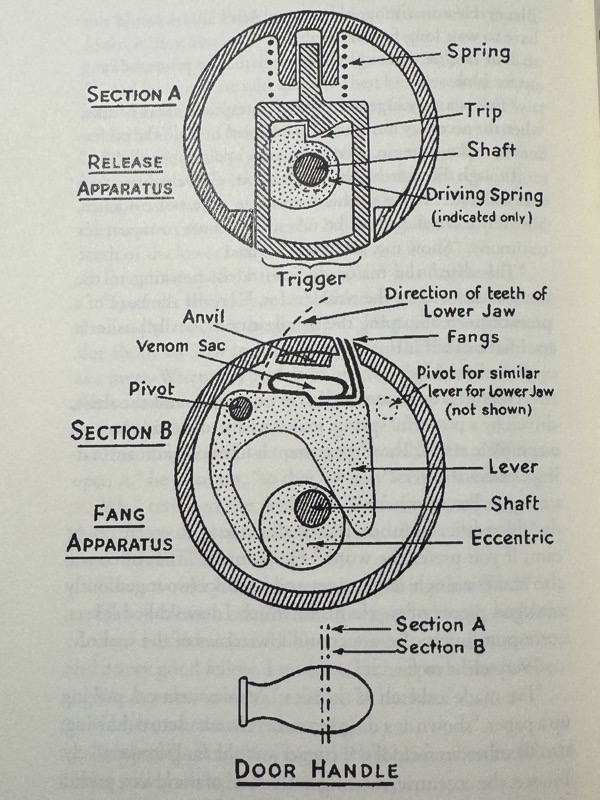
In other news, Fang Apparatus is the name of my new band.
Speaking of bands, and bear with me as I develop this comparison, but in a way Crofts reminds me of Roger Waters. Waters has said that in Pink Floyd he and Nick Mason were the group’s architects while David Gilmour and Richard Wright were the musicians. Sometimes when he tells this story he complains that Gilmour and Wright looked down on him; other times he insists that the architects are the real bosses because you can always hire musicians — they lie thick on the ground, but an architect is a rara avis. (Waters actually studied architecture before turning to music.)
Crofts too is an architect, and puts all his best energies into construction. He couldn’t be bothered with the music of language, with wit, with nuances of character; he didn’t see those as essential to success in writing a detective story. Even though Crofts was a religious man, when he brings a religious theme into Antidote to Venom he treats it as quickly and cursorily as possible; he seems embarrassed to have brought it up.
Me, I’m a music guy, in fiction and actual music alike. If I had to choose between Waters/Mason and Gilmour/Wright, I’m taking the latter pair every time: their contributions to the Floyd seem to me to dwarf those of Waters, who, given his freedom, inevitably sank into dreary pretentiousness and tub-thumping. If he had been a novelist, he’d have written over and over and over, “If only she would die!”
