When you’re teaching Thomas Aquinas and are trying to fill in the theological background, you need a big board. (I misspelled homoousios, but oh well.)
Tag: theology (page 2 of 3)

Very nice to see from Crossway these lovely new editions of some of Jim Packer’s books.

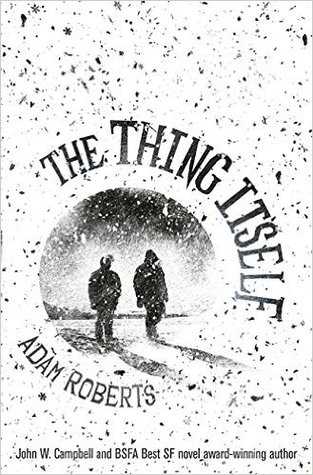
I read Adam Roberts’s Purgatory Mount in draft, and struggled to know what to make of it. I have now read its final version, and find it an exceptionally resonant and moving story – though I acknowledge that people who aren’t comfortable with Adam’s peculiarly associative intelligence (imagine his mind comprised of chess pieces, all of them knights) may find some of the narrative linkages he forges here difficult to parse. And Adam shares with certain other writers, most notably Auden and Pynchon, a tendency to cast his most serious inquiries in comic form.
As I set the book aside, I found myself thinking several thoughts:
- That culture is what we humans make together;
- That culture is memory;
- That memory is imperfect;
- That among the things we remember will always be sins and wrongs, those done to us, and those we do to others;
- That the Book of Common Prayer teaches us something utterly inevitable about “these our misdoings,” namely that “the remembrance of them is grievous unto us, the burden of them is intolerable”;
- That, therefore, much of the essential work of culture – always – is the addressing of such remembrances and such burdens; and, finally,
- That this work must often be done in extraordinarily difficult circumstances, not least because of the imperfections of memory and the imperfections of the people who remember.
Some years ago Adam and I joined with Rowan Williams and Francis Spufford for a theological conversation about Adam’s novel The Thing Itself; Purgatory Mount is also a novel that cries out for theological reflection. I hope it gets it.
The two epigraphs that Adam prepends to his story are wisely and wittily chosen, but I would like to suggest one more, from “East Coker”:
There is only the fight to recover what has been lost
And found and lost again and again: and now, under conditions
That seem unpropitious. But perhaps neither gain nor loss.
For us, there is only the trying. The rest is not our business.
This is a fascinating essay by my friend Charles Marsh. For me, there are two major elements of fascination, and I want to take them one at a time.
One: The experience Charles describes – mainly in the central section of his essay – of responses to his book Strange Glory from certain other Bonhoeffer scholars is eerily familiar to me as a biographer of C. S. Lewis. When my biography came out, a number of Lewis scholars wrote reviews, or wrote to me personally, to tell me that I had made terrible factual errors. My skin crawled when I heard those charges; I feared exposure of my inadequacies and subsequent humiliation; but then when with trembling fingers I grabbed my books and checked to see whether I had indeed failed so badly, I discovered that in almost every case I had not. Most of what they called factual errors on my part were simply differences of opinion or interpretation; they were so wedded to their view of Lewis that they could not see disagreement with it as anything but falsehood. In other cases they confidently corrected statements I made, but obviously did so from memory, without checking the relevant sources. From one person I got a twenty-page printout listing errors I had made, which in panic I went over with a fine-toothed comb and discovered that not one accusation of error in the entire twenty pages was accurate. (My book does of course contain errors, some of them embarrassing to me; but oddly enough, my confident critic tended to miss those.)
After a period of receiving these letters and reviews with decreasing panic, I finally came to realize that while the responses claimed to be identiying errors, they really had nothing at all to do with truth or falsehood in scholarship. They were statements by people who perceived themselves to be the faithful custodians of the C. S. Lewis brand — note the title of Charles’s essay — and to them I was an outsider to that custodianship. When they said that Jacobs makes many factual errors, they weren’t even really making a truth claim, they were uttering a spell to ward off the stranger. They were placing me outside their Inner Ring. Once I understood that this was no scholarly endeavor but rather a ritual for maintaining group purity, I stopped worrying about what they said about me.
It seems to me that Charles is in a similar situation, especially with regard to Ferdinand Schlingensiepen, whose criticisms of Strange Glory are inconsistent – he can’t seem to decide whether the flaw of Charles’s book is that it’s too creative or not creative enough – when they aren’t extravagantly petty. From my distance I can’t be sure, of course, but Schlingensiepen certainly looks like a Guardian of the Brand. Charles is outside that Inner Ring. Again and again Charles shows that the accusations of major error are incorrect – of course he made some minor ones, as we all do – but to Guardians of the Brand that will not matter. They have uttered their spell. I think Charles will simply have to content himself with having written an outstanding biography that engages with constant critical sympathy one of the major theological figures of the 20th century, and tells a fascinating story to boot.
Two: The second theme, and one I want to keep thinking about, is Charles’s observation that there are very few good biographies of theologians. This strikes me as being absolutely true, and somewhat worrisome. Too many theological biographies are, as Bethge’s biography of Bonhoeffer was, mere chronicles: useful, informative, but neither illuminating nor inspiring. I can think of a couple of others, which I shall not name here, that aspire to be something more but are dragged down by a turgid prose style. The great theologians need and deserve vivid narratives, but vividness in storytelling is not a virtue that many theologians possess. So perhaps the biographies of theologians will need to be written by non-theologians, except in those rare cases when someone like Charles can be found: learned in his field but also with writerly gifts.
There is another potential issue, related to the matter of Brands: the great theologians tend to be controversial figures — founders of schools and therefore, indirectly, of counter-schools. In relation to the inevitable disputes, the biographer must offer a mere chronicle, as noted above; or take sides (explicitly or implicitly); or find a way to fend off readers who might think that he or she is taking sides. Navigating such obstacles doesn’t often make for a well-told tale, which is why Guardians of the Brand never write good biographies. But: disputes occur in other fields too. There aren’t many philosophers more controversial than Bertrand Russell and Wittgenstein, and yet Ray Monk’s biographies of them are absolutely masterful. How wonderful it would be if Karl Barth and Hans Urs von Balthasar and John Webster and Robert Jenson all found their Ray Monk.
All this makes me want to write a biography of a theologian. Unfortunately I don’t know much about theologians.

(The inside front flap of my old and much-used copy of Barth’s commentary on Romans.)
This is a story well known to many, but it’s worth recalling.
When Karl Barth was a young pastor in Switzerland and the Great War had recently begun, he read the “Manifesto of 93,” in which a large number of German scholars in the arts and sciences loudly denounced the claims made in the Allied nations that Germany had in any way been an aggressor in the current war, and pledged themselves to the service of German nationalism. Barth was appalled. And he was especially appalled when he saw how many of the signatories were his former teachers, in theology and biblical studies. He had already distanced himself to some degree from the easy comforts of 19th-century liberal Protestant theology, in which Christianity was a pleasant and useful addendum to a confident humanism. But at this point Barth began to ask whether there might be a substantive — a causal — relation between these professors’ theology and their embrace of German nationalism.
As he was reflecting on these matters, he found himself faced with the task of preaching some sermons on Paul’s letter to the Romans. And in preparing to deliver those sermons, he gradually came to see that the most powerful imaginable explanation for the behavior of his former teachers was to be found in the letters of Paul, and especially this one, the longest and greatest of Paul’s letters.
It was suddenly quite clear to Barth what had happened to his teachers: they had domesticated and trivialized the God of Scripture, they had made him no more than an appendage to a humanistic project that was going to go on whether God supported it or not. And this domesticated God quickly and easily gave way to another God who made greater demands upon its adherents: German nationalism. Having made the Christian God so much smaller, these theologians and biblical scholars prostrated themselves before the demands of the powerful god of German military might and cultural superiority.
It was at this point that Barth returned to his reading of Paul with increased urgency. In his preface to the commentary that eventually emerged, just as the war had ended, Barth said that historical scholarship could certainly show the ways in which Paul was a figure of his own time. But what historical scholarship could not show, and what was absolutely necessary to be seen, was that Paul is our contemporary: he speaks to us from the heart of our experience. And in so speaking, he crushes our idols. To hear Paul as a contemporary became Barth’s great project and challenge — and when he had done so, he had a direction for his theology, a direction he would pursue for the rest of his life.
I cannot imagine anything more salutary for American Christians today, on the left and on the right, politically and theologically, than a genuine and unguarded encounter with this terrifying figure we call Paul the apostle.
[Re: the writers of Job, the Psalms, Isaiah:] Their theme — and it is the proper theme of history — is not concerned with denying or affirming what men are IN THEMSELVES; it is concerned with the perception of the uncertainty of men in relation to what they are not, that is to say, in their relation to God who is their eternal Origin. Thence comes their radical attack! It has nothing to do with that relative criticism which must, of course, be exercised upon all religion, ethics, and civilization. For the same reason, it cannot remain satisfied with that relative approval which must be awarded to every human achievement when placed in its own context. The disturbance lies far deeper and is infinitely more than mere unrest, for it reaches out to a peace which is beyond the experience of normal human life. Its negation is all-embracing, since it proceeds from an all-embracing affirmation. Those who lead this attack are moved neither by pessimism, nor by the desire of tormenting themselves, nor by any pleasure in mere negation; they are moved by a grim horror of illusion; by a determination to bow before no empty tabernacle; by a single-minded and earnest striving after what is real and essential; by a firm rejection of every attempt to escape from the veritable relation between God and man; by a genuine refusal to be deceived by those penultimate and antepenultimate truths with which human research has to be content both at the beginning and at the end of its investigation. They allow full right to the materialistic, secular, “sceptical” view of the world; and then, assuming this final scepticism, they set forth upon the road which leads to the knowledge of God and thereby to the knowledge of the eternal significance of the world and of history. No road to the eternal meaning of the created world has ever existed, save the road of negation. This is the lesson of history.
— Karl Barth, commentary on Romans 3

My friend Adam Roberts has recently released a delightful and provocative little book called It’s the End of the World: But What Are We Really Afraid Of? It’s not about the end of the world, but about the stories we tell about the world’s end — and why we tell them.
The central idea of his interpretation is announced fairly early on, in a discussion of Ragnarök — and what comes after Ragnarök:
The end turns out not to be the end – Ragnarök turns the universe off and on again. We still can’t bring ourselves to come to terms with the total absence of life. Something must continue, something must exist. And so we are locked into a cycle – imagining an end to the story, but afraid to really bring it to an end once and for all. This, counter-intuitively, turns out to be one of the most reliable features of all the stories about the end of the world. A world ends. The world never does.
In fact sometimes it does, and in texts Adam cites: Byron’s terrifying poem “Darkness,” the unsurpassably bleak vision at the end of H. G. Wells’s The Time Machine, etc. But yes, it is true that far more often than not the end of the world is the portal to a renewed cosmos: the New Heaven and the New Earth of John the Revelator’s vision; the end of this kalpa leading to the eventual emergence of another.
Having laid out this general framework, Adam moves on to instances, brief sketches of what we might call the various genres of conclusion: endings brought about by the gods, by zombies, by plagues, by machines, by the heat death of the universe, by climate change. You can see that for some of these the relevant phrase is “the end of the world,” while for others it’s “as we know it.” Climate change won’t end the world, though it will certainly reshape it; and as Adam writes, “the secret core of the zombie story” may be that it describes “not so much the end of the world, but the end of the values that underpin that world – not the end of humans as a species but of our very humanity.” (There’s a very stimulating comment in that chapter on Huxley’s Brave New World as a kind of zombie story.)
There’s also a fabulous digression on the horror of a world that won’t end: I’m compelled by Adam’s description of Groundhog Day as “a masterpiece of supreme existential terror.”
In his final pages he writes, “We use the stories to make sense of it all, to impose order on an uncaring and chaotic universe, creating the fantasy that we have some measure of understanding and control.” That’s something close to the book’s conclusion, but I think it conflates several different experiences. The problem lies in the phrase “understanding and control.” Understanding and control are not the same thing, and I’m not even sure they arise from the same impulse. After all, one of the things that we might understand about the world, or about our lives in more specific ways, is that we don’t have any meaningful control over it or them.
I think it’s fair to say that Adam shares the view articulated by Wells at the the of The Time Machine and by Byron in his great poem:
The waves were dead; the tides were in their grave,
The moon, their mistress, had expir’d before;
The winds were wither’d in the stagnant air,
And the clouds perish’d; Darkness had no need
Of aid from them — She was the Universe.
If that vision is true, then to grasp that is certainly to understand something; but it is not to control anything, except perhaps — perhaps — our hopes for something better. The control of emotion that one achieves when one accepts what one cannot control: Stoicism in a phrase.
Which leads us back to one of Adam’s key points, that all of our stories about the end of the world are really, to some degree and often to a very great degree, refractions of our sense of our own ending, our own death. And Larkin, for one, didn’t think much of the Stoic answer:
Courage is no good:
It means not scaring others. Being brave
Lets no one off the grave.
Death is no different whined at than withstood.
One may control one’s fear, but that’s not the control that any of us wants. I think Larkin has understood something here.
For me, a Christian, everything about this, about what will happen to me when I die, about what will become of this sweet world, hinges on one question. As Auden put it: “Now did He really break the seal / And rise again?” The biggest of all Ifs, for me. But I’m staking my claim on “Yes.” And I think, along with the say-but-the-word centurion given voice by Les Murray,
If he is risen, all are children of a most real high God
or something even stranger called by that name
who knew to come and be punished for the world.
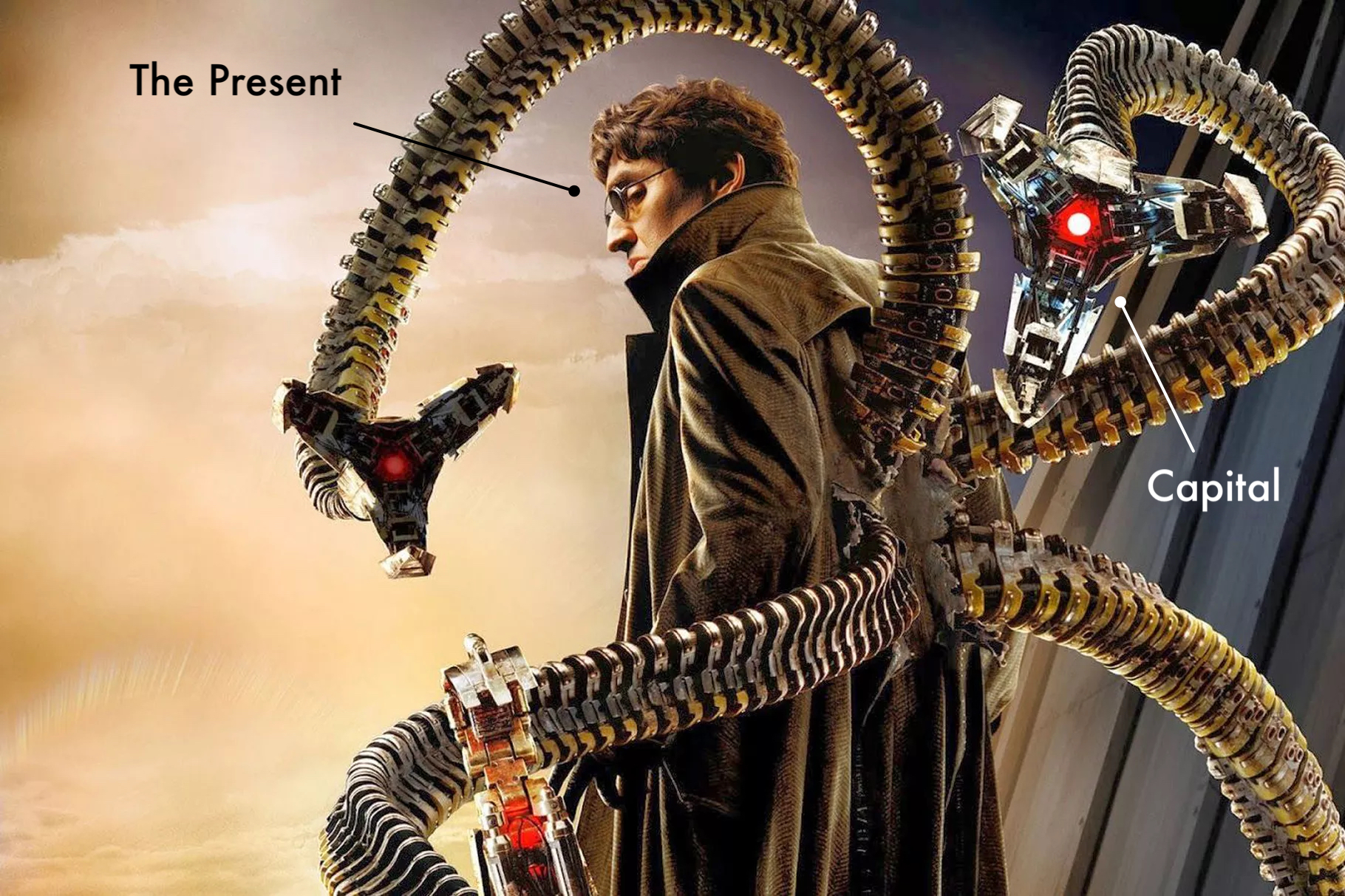
I’ve been thinking a lot lately about the idea of the present moment as a Power, a power in the Pauline sense of a massively distributed, massively influential, universal agency directing the course of this world. It seems to me that the Present is a jealous God: it wants us to think only of itself, and never of the past or the future except insofar as images of them serve this instant.
But if we must think of either the past or the future, the Present prefers for us to think of the future, for two reasons: one, any future we imagine is just that, imaginary, and is really a kind of projection of our hopes and fears for our own moment. And two, thinking about the future produces anxiety, which has the effect of driving us back towards the Present, where we can be distracted from that anxiety. That is to say, the future is potentially useful to the Present in a way that the past is not.
Now, to be sure, we can interpret the past in such a way that we reinforce our current habits and attitudes and prejudices. (I have written about this in Breaking Bread with the Dead.) But this is of limited usefulness to the Present and is not really worth the risks. From the perspective of the Present, any genuine immersion in the past is likely to complicate our understanding of this moment and make it harder for us to know precisely what to do, because of all the complexity, good and bad, of the behavior of those who lived and fought and prayed and loved before us. If we learn to have compassion for those people, we just might translate that into compassion for the people who share this world with us but do not think just as we think. And that the Present cannot have.
Why does the Present not want this? Because present-mindedness is instantaneousness, it is automatic response, it is the gratification of whatever emotion happens to arise. As the poet Craig Raine has said, “all emotion is pleasurable” — this fact is the constant pole star of the Present.
These thoughts, though they’ve occupied me for a long time, were recently brought to the forefront of my mind by an essay on Harper Lee by Casey Cep, which contains this passage:
There is an important and interesting conversation happening now about the relevance of To Kill a Mockingbird to our country’s pursuit of racial justice and how we teach civic virtues like tolerance. For a long time, Lee’s novel has been one of the most banned books in the country, first criticized by conservatives who disapproved of its integrationist politics, then by liberals who disapproved of its use of racial slurs, and all along by censors of all persuasions who object to its depiction of rape and incest. Lately, though, the novel’s detractors are not calling for a ban or censorship, just retirement: taking it off of syllabi in order to make room for books by a more diverse group of authors, offering students work written with an eye to the current fight for racial justice, not one from the last century.
I don’t really care whether people keep reading To Kill a Mockingbird. What interests me about this paragraph is the idea — and it’s not necessarily Cep’s idea, just one that she rightly discerns as common — that there is a “current fight for racial justice” that’s different from “one from the last century.” But, you know, Dorothy Counts is still alive.

And Ruby Bridges is still alive — indeed, just now reaching retirement age.

John Lewis, the last of the Big Six, just died a few months ago. I myself remember quite vividly the integration of Birmingham’s schools. This isn’t ancient history we’re talking about, and we shouldn’t allow the artificial convention of “centuries” deceive us into believing that it is. The story of Dorothy Counts and Ruby Bridges and John Lewis and all the rest of those amazing people who now get lumped into that comforting abstraction we call the Civil Rights Movement is our story, though the Present wants us to forget that, wants to separate us from our brothers and sisters, wants to break all chains that link us to one another — so that we can be wholly absorbed into Now and indulge our instantaneous emotions rather than reflect thoughtfully on the ways that the past is not dead, it is not even past.
The Present wants to infect us with what I have decided to call palaiphobia, from παλαιός, palaiós, old, worn out. That’s how it alienates us from one another, makes us wholly dependent on what it can offer: sentimentality and rage.
UPDATE: My friend Adam Roberts has, quite justifiably, wondered whether my coinage uses the right word. Here’s what I wrote in reply to him:
I have to say something about my decision to write of palaiphobia rather than archephobia. It was an agonizing one, I assure you. In these matters I take my bearings primarily from New Testament Greek, as you know, and of course there’s considerable overlap between the two words. When Paul writes in 2 Corinthians 5 that the old has gone and the new is here, he uses ἀρχαῖα; but when he talks about the “old leaven” in 1 Corinthians 5 he uses παλαιὰν ζύμην. As far as I can tell ἀρχαῖα and παλαιὰν would be interchangeable in those contexts. Both words can be neutral in their valence. But if you look at the overall patterns of usage, it seems that there’s something more generally disparaging about παλαιὸς, whereas there’s at least a potential dignity in ἀρχαῖα. When Paul talks, as he often does, about the “old man” that we must put off, he says παλαιὸς ἄνθρωπος. And παλαιὸς often has the connotation of something worn out, as when Jesus talks (in Matthew 9:16) about patching old clothes, ἱματίῳ παλαιῷ. I wanted to capture that disparagement in my coinage, the sense that the past is worn out, useless, of no value. I wonder if you think that makes sense?
UPDATE 2: after a conversation with Robin Sloan:

Here is where Temple still matters as a theorist of guild socialism. In the early 1940s, both before and after he became Archbishop of Canterbury, Temple got very specific about how to democratize economic power. He was incredulous that modern democracies tolerated big private banks, lamented that Christian socialists turned away in the 1890s from the land issue, and proposed a new form of guild socialism. The banks, he argued, should be turned into utilities or socialized; otherwise the rich controlled the process of investment. God made the land for everyone, and society creates the unearned increment in the value of land; therefore the increment should go to society. Above all, though Temple took for granted that certain natural monopolies must be nationalized, the centerpiece of his proposal was an excess-profits tax payable in the form of shares to worker funds. These funds, over time, would gain democratic control over enterprises. Economic democracy, he argued, can be achieved gradually, peaceably, and on decentralized terms, without abolishing economic markets or making heroic demands on the political system.
The ultimatum complains that, in its view, past initiatives aimed at enlarging the number of faculty of color at Princeton have “failed” because in 2019–20 “among 814 faculty, there were 30 Black, 31 Latinx, and 0 Indigenous persons. That’s 7%.” According to the ultimatum, this “is not progress by any standard; it falls woefully short of U.S. demographics as estimated by the U.S. Census Bureau, which reports Black and Hispanic persons at 32% of the total population.”
The suggestion that these statistics show racial unfairness in hiring at Princeton is misleading. According to the Journal of Blacks in Higher Education, African Americans in recent years earned only around 7 percent of all doctoral degrees. In engineering it was around 4 percent. In physics around 2 percent. Care must be taken to look for talent in places other than the familiar haunts of Ivy League searches. But even when such care is taken, the resultant catch is almost invariably quite small.
The reasons behind the small numbers are familiar and heart-breaking. They include a legacy of deprivation in education, housing, employment, and health care, not to mention increased vulnerability to crime and incarceration. The perpetuation of injuries from past discrimination as well as the imposition of new wrongs cut like scythes into the ranks of racial minorities, cruelly winnowing the number who are even in the running to teach at Princeton.
The racial demographics of its faculty does not reflect a situation in which the university is putting a thumb on the scale against racial-minority candidates. To the contrary, the university is rightly putting a thumb on the scale in favor of racial-minority candidates. That the numbers remain small reflects the terrible social problems that hinder so many racial minorities before they even have a fighting chance to enter into the elite competitions from which Princeton selects its instructors. The ultimatum denies or minimizes this pipeline problem.
Many of Ambrose’s contemporaries were quietly convinced that the ills of Roman society had a supernatural origin. Many of the sharpest critics of their age were not Christians; they were pagans. For them, bad times had begun with the “national apostasy” of Constantine. The rampant avarice denounced by pagan authors was thought to go hand in hand with the spoliation of the temples and the abandonment of the old religion.
Ambrose had to answer such views. He did so by subtly secularizing the contemporary discourse on decline. He turned what many thinking persons considered a religious crisis into a crisis of social relations. We moderns tend to applaud Ambrose for the perspicacity of his diagnosis of the weaknesses of Roman society. But pagans such as Symmachus would have regarded Ambrose’s criticisms of society as mere whistling in the dark. Symmachus knew why things had gone wrong. The moment that the first fruits of the fields of Italy that had fed the Vestal Virgins for 1,200 years were withdrawn (in 382), the link between the land and the gods was broken.
In these posts on “critical theory,” I’m doing what I pretty much always do: I am separating and sorting questions that tend to be conflated. That’s my thing, right? It’s why I wrote a book called How to Think, and why I say, in a blog post, that “it seems to me that arguments about Christianity and politics have an almost unique ability to reduce the intelligence of the people involved by at least a third. We desperately need clarity about what, exactly, we’re arguing about.”
So, in that spirit, onward! — with apologies for self-quotation. A number of these issues I have dealt with before, sometimes at greater length. Here I’m trying to sum up what I think are the key theological themes we need to keep in mind when evaluating what people are determined to call “critical theory.” It’s a bit of a stepping back from the details.
ONE: As noted in an earlier post, some of the questions raised by “critical theory” are empirical ones. Has the history of what became the United States been deeply, indeed essentially, implicated in the slave trade since 1619? Is our society still dominated by white supremacy? Is our social and political order structurally racist? To answer these questions is to evaluate historical and sociological evidence. You could be a deeply orthodox Christian and answer “Yes” to all those questions. You could also be a deeply orthodox Christian and answer “No” to them all. It would depend on the evidence you gather and how you evaluate it.
TWO: But — and here’s where things get complicated — the people who hold the political views mentioned above tend to hold other views that are philosophically unrelated to the historical claims. Indeed many people who are not “woke” at all in their thinking about race also hold these views, which cluster around what I have called “metaphysical capitalism”: I am a commodity owned solely by myself; I may do with this property whatever I want and call it whatever I want; any suggestion that my rights over myself are limited in any way I regard as an intolerable tyranny. I am what I say I am. I am my own. As a Christian I do not and cannot believe this. My only comfort in life and in death is that I am not my own, but belong with body and soul, both in life and in death, to my faithful Saviour Jesus Christ.
But how can I communicate this to people who aren’t Christians? Can I give them any reason to believe that they are not their own without invoking Jesus? Is there some kind of political principle accessible to non-believers that would encourage them to overcome the I-am-my-own principle? I hope so, because I think that self-ownership is destructive to the self and damaging to that self’s community. But in a plural and indeed pluralist society it’s difficult to know how to make such arguments effectively. I have tried to explore some of these issues in this essay, which, though it is largely about intra-Christian disputes, has relevance for the larger social body. I hope.
THREE: More generally, we need a great disentangling. You can see from the above how philosophically unrelated claims get entangled with one another and can seem to belong to the same general movement even when that’s logically impossible. One cannot simultaneously be fundamentally defined by one’s group identity and free to be whatever one wants to be. The attempt to hold both views at once without acknowledging their incompatibility is what leads to situations like the Hypatia transracialism controversy, in which a single academic article shorted out the entire system. Similarly, the doctrine of “intersectionality” tends, as I have written in this blog post, to focus on intersections that intensify but to ignore intersections that cancel each other out. The problem with the Ongoing Oppression Thesis is not that it’s wrong about ongoing oppression, but that the people who deploy it tend to think they need in any given situation to have a clear victim and a clear perpetrator. That’s morally simplistic, and also cannot account for the distributed character of power, as I explain in this interview: “I’ve got a chapter in my book [The Year of Our Lord 1943] called ‘Demons,’ about demonic activity. Or if you don’t want to say ‘demonic’ activity, you can call it the activity of what St. Paul calls the ‘principalities and powers.’ It’s interesting, Foucault is a kindred spirit — the ‘principalities and powers’ is a kind of Foucauldian argument, right? In the sense that it is power — and what Weil would call force — disseminated through social and political structures.” That whole interview is relevant to a lot of the questions I’ve been exploring in these posts. It’s an attempt to think in as thoroughly biblical a way as I can manage about these questions.
FOUR: The final set of questions relates to what I will call, for lack of any catchy and concise term, the practical implications of theological anthropology. My point here is closely related to the previous one. Whatever Christians think about the issues I have raised above, we are obliged to conduct ourselves in ways that avoid what I call “rhetorical Leninism.” We have to extend mercy to those whom we believe to be wrong, even tragically wrong, because this is how God treats us. He loves the unlovely, and is gracious to the wicked — like me. We are to be imitators of Him. For us there can be no “Lord, I thank you that I am not like that racist over there,” or “Lord, I thank you that I am not like that pathetic cuck over there” – there can only be “Lord Jesus Christ, Son of God, have mercy on me a sinner.” Because when we choose to measure others according to a certain standard, we are asking that that same measure be used to measure us.
Okay, that’s it, I’m done. No more from me about this — though I am, as I mentioned earlier, engaged with some colleagues on a project that will address many of the issues at stake here. But that has to remain a Big Secret for now.
It has come to my attention that some among you don’t believe death is a very bad thing; or at least that there are many things more precious than life. This is in fact not true; life is the greatest of the gifts of God, because it is the one that makes every other gift possible. This is why we often honor those who sacrifice their own lives in order to save others. They give up something of unique value to themselves; we think of this as the greatest of sacrifices for a reason.
This is also why people who refuse to compromise their strongest commitments even when it leads to their own death are so greatly praised and long remembered. When people do this for their Christian faith we call them martyrs — witnesses to that faith — and we give them the highest praise, because of how much their obedience and faithfulness cost them. We never expect people to be martyrs, and have compassion for those who fail to rise to that height.
But when people do give up their lives in such praiseworthy ways, why do they do so? They always do it for life: they give up their own so that others may have life and have it more abundantly. “Ah,” some of you may say, “but that refers to spiritual life.” That, my child, is an error. It is certainly true that we may distinguish between bios and zoe, but in this created order you cannot have the latter without also having the former. We are made embodied creatures and will remain so: this is why the resurrection of the body is the penultimate item of our Creed. This is also why Christians have historically practiced burial rather than cremation, as a sign that we love and treasure the physical body and hope to see it filled with life again, just as the dry bones in the valley Ezekiel saw regain sinew and then breath.
Now, some of you have already perceived where I am going next. If life is so very good, does it not follow that death is proportionately bad? Yes, my child, you have rightly discerned the logic! Death, let us remember, is the curse laid upon Adam and Eve, and all of us since, for disobedience — and it is a mighty curse. When Jesus sees a gathering at Bethany weeping for the death of Lazarus, he too weeps; he too “is greatly disturbed.” (Les Murray: “he mourned one death, perhaps all, before he reversed it.”) Death is our great enemy — indeed, as St. Paul tells us, “The last enemy that shall be destroyed is death.”
Our lives are not our own — as the Heidelberg Catechism teaches me, my only comfort in life and death is that I am not my own, but belong body and soul to my faithful savior Jesus Christ — but stewardship begins with our physical lives. We are to care for them, treasure them, take great pains to preserve them — and we are to do the same for the lives of our neighbors. And if we are ever called upon to give up our lives, we should do so only for the sake of the lives of our neighbors. We should certainly take greater care for their lives than we do for our own; but that is saying a lot, for we are accountable to God for the lives he has given us.
All this is so elementary, so basic to Christianity that it should not need to be spelled out. But apparently it does.
Folly is a more dangerous enemy to the good than evil. One can protest against evil; it can be unmasked and, if need be, prevented by force. Evil always carries the seeds of its own destruction, as it makes people, at the least, uncomfortable. Against folly we have no defence. Neither protests nor force can touch it; reasoning is no use; facts that contradict personal prejudices can simply be disbelieved indeed, the fool can counter by criticizing them, and if they are undeniable, they can just be pushed aside as trivial exceptions. So the fool, as distinct from the scoundrel, is completely self-satisfied; in fact, he can easily become dangerous, as it does not take much to make him aggressive. A fool must therefore be treated more cautiously than a scoundrel; we shall never again try to convince a fool by reason, for it is both useless and dangerous.
If we are to deal adequately with folly, we must try to understand its nature. This much is certain, that it is a moral rather than an intellectual defect. There are people who are mentally agile but foolish, and people who are mentally slow but very far from foolish — a discovery that we make to our surprise as a result of particular situations. We thus get the impression that folly is likely to be, not a congenital defect, but one that is acquired in certain circumstances where people make fools of themselves or allow others to make fools of them. We notice further that this defect is less common in the unsociable and solitary than in individuals or groups that are inclined or condemned to sociability. It seems, then, that folly is a sociological rather than a psychological problem, and that it is a special form of the operation of historical circumstances: on people, a psychological by-product of definite external factors. If we look more closely, we see that any violent display of power, whether political or religious, produces an outburst of folly in a large part of mankind; indeed, this seems actually to be a psychological and sociological law: the power of some needs the folly of the others.
— Dietrich Bonhoeffer, “After Ten Years” (1943)
In yesterday’s post I quoted from Deirdre McCloskey’s work on bourgeois life, and I want now to return briefly to that. Late in the first volume of her trilogy she refers to a 1945 book called The Economic Order and Religion:
It develops that Knight and Merriam are arguing that social life in a large group with thoroughgoing ownership in common is impossible. That is what they believe Christian love entails. Their source is always the gospels, never the elaborate compromises with economic reality of other Christian writers, such as Paul or Aquinas or Luther, or the thirty-eighth article of the Anglicans: “The riches and goods of Christians are not common, as touching the right, title, and possession of the same, as certain Anabaptists do falsely boast.”
What, the Gospels aren’t supposed to count? Methinks they count indeed. But I can understand why someone looking at Luke 12:33 and Luke 14:33 might want to quickly turn aside. In any case, it’s not just the Gospels that tell this story: we also have (and Hart cites) the book of Acts and the letter of James. If McCloskey is going to argue that we should imitate “the elaborate compromises with economic reality of other Christian writers,” then she really needs to say why we should follow those “other writers” when they disagree, or at least certainly seem to disagree, with the Gospels, Acts, and James.
And as we think about all these matters we should surely remember Kierkegaard’s comment that most Christians think that the commandments are intentionally over-severe, like setting our clocks ahead half-an-hour to make sure we get up in the morning. (He can’t mean what he says.)
As always: the evidence all seems to point in one direction when you ignore or suppress all the evidence that points in the other direction.
Auden’s single greatest poetic achievement, I think, is his sequence “Horae Canonicae,” which begins with the first hour of the prayerful day, Prime. Here is a stanza from Auden’s poem in which he describes something that always interested him, the experience of waking up:
Holy this moment, wholly in the right,
As, in complete obedience
To the light’s laconic outcry, next
As a sheet, near as a wall,
Out there as a mountain’s poise of stone,
The world is present, about,
And I know that I am, here, not alone
But with a world and rejoice
Unvexed, for the will has still to claim
This adjacent arm as my own,
The memory to name me, resume
Its routine of praise and blame
And smiling to me is this instant while
Still the day is intact, and I
The Adam sinless in our beginning,
Adam still previous to any act.
Most of Auden’s critics know that he read Heidegger, and it’s easy to hear here an echo of Heidegger’s idea of “being thrown” (Geworfen) into the world. John Fuller also finds here echoes of Husserl and Paul Valéry. And all that may be true, but I wonder if there might be another source: Beowulf.
In the genealogical section with which Beowulf begins, we’re told that Halfdane had four children, though that’s not quite how the poet puts it. The poet says that four bearn — as some Scots still say, bairns — “woke into the world”:
ðaém féower bearn | forðgerímed
in worold wócun
And isn’t that what Auden is talking about? The daily birth, the daily waking into the world.
Maybe, maybe not. But it would be very characteristic of Auden to write a poem which blends an idea of Heidegger’s with a phrase made by the Beowulf poet.
Also, if when we are born we wake into the world, in death, we part from it: worulde gedál. That word gedál means “parting” or “separation,” but the Germanic root also means “valley.” When we die we are parted from the world: we take a last look at it, perhaps, across the great valley that separates us. Late in Auden’s sequence, at the hour of Compline, as he moves towards sleep at the end of a day that has seen the incomprehensible sacrifice of “our victim,” he writes:
Nothing is with me now but a sound,
A heart’s rhythm, a sense of stars
Leisurely walking around, and both
Talk a language of motion
I can measure but not read: maybe
My heart is confessing her part
In what happened to us from noon till three,
That constellations indeed
Sing of some hilarity beyond
All liking and happening,
But, knowing I neither know what they know
Nor what I ought to know, scorning
All vain fornications of fancy,
Now let me, blessing them both
For the sweetness of their cassations,
Accept our separations.
Consider this a follow-up to my recent posts on metaphysical capitalism and some stories about the commodification of emotion and connection — and also a kind of pendant to Derek Thompson’s story in the Atlantic on the religion of workism. This one’s gonna have some long quotations.
Here’s how Kathryn Tanner describes her task in her new book Christianity and the New Spirit of Capitalism:
Whether amenable to capitalism at its start or not, my own Christian commitments as I hope to show are inimical to the demands of capitalism now. I am critical of the present spirit of capitalism because I believe my own, quite specific Christian commitments require it. But I also suggest over the course of the chapters to come that the present-day organization of capitalism is deserving of such criticism whatever one’s religious commitments, because of its untoward effects on persons and populations, its deforming effects on the way people understand themselves and their relations with others. Every way of organizing economic life is flawed. Besides having especially egregious faults (relative to other ways that capitalism has been organized, this one foments, for example, extreme income/wealth inequality, structural under- and unemployment, and regularly recurring boom/bust cycles in asset values), what is unusual about the present system is the way its spirit hampers recognition of those faults. The present-day spirit of capitalism needs to be undermined, therefore, in order for the current system to be problematized — seen as a problem amenable to solution, an object of possible criticism requiring redress. And in order for that to happen, in order for the spirit of present-day capitalism to be effectively undermined, it needs to be met, I suggest, by a counter-spirit of similar power. Without the need any longer of religious backing, capitalism may now have the power itself to shape people in its own image; its conduct-forming spirit may now be its own production, in other words. But as one of the few alternative outlooks on life with a capacity to shape life conduct to a comparable degree, religion might remain a critical force against it.
That bolded sentence is a reminder that, as I often say, “the liberal order catechizes,” and that it will catechize us right out of Christianity altogether if we don’t provide what I call a “counter-catechesis,” a radically different “conduct-forming spirit.” Tanner makes a very similar argument at length.
In so doing, she repeatedly reminds us that Christianity is, among other things, a counter-economics. Everyone knows how thoroughly economic language is woven into the fabric of the Christian story: we are bought with a price (agorazo); we are bought out of slavery (exagorazo). Though Tanner doesn’t do exegesis in her book, it’s clear that she wants her readers to understand how completely the biblical picture reorients, or ought to reorient, our self-understanding. In a capitalist order it becomes easy, even natural, to think of God as a metaphysical banker, keeping our moral accounts as thoroughly as the hidden gods of capitalism track our FICO scores. But if we can escape that tendency, if we can understand God as the one who has delivered us from bondage, then “rather than being tallied against one’s account, one can be assured one’s sins are forgiven, their burden erased, when casting them upon Christ’s mercy in confession. One can honestly admit faults without fear, assured of God’s mercy in Christ. It is not the lapse that threatens to separate one from Christ but the refusal to confess it, out of fear and a lack of trust in God’s graciousness.”
But if we cannot manage this reorientation of our understanding, then we can come to be terrified of the future and at the same time confined to an understanding of the future as a mere continuation of what now exists:
In order to profit from the difference between present and future, or at least to prevent it from doing any harm, one employs financial instruments that collapse the future present — that is, what the future will turn out to be — into the present future — that is, into the present view of the future…. By virtue of such a collapse of future into present, the future one anticipates loses its capacity to surprise; the future to come simply reduces to the future it makes sense to expect given present circumstances. Those circumstances themselves become a kind of self-enclosed world, as one learns to hope for nothing more from the future than what the given world’s present limits allow, what it is reasonable to expect from within them, assuming their continuance.
To live within these constraints — constraints which our capitalist order teaches us we must think about constantly if we are to be rational actors and responsible citizens — is to be deprived of both imagination and hope. What is required, for those of us so bound, is to be redeemed from this bondage, to be bought ought of slavery to it, and that requires conversion.
So I was delighted to find, at one important juncture in this book, this liberal Episcopalian giving her readers what amounts to an altar call. I’ll close with that call:
The present does not, however, become urgent here due to scarcity. One has everything one needs — more than one needs — to turn one’s life around: the grace provided in Christ. In marked contrast to the efficiency-inducing scarcities of finance-dominated capitalism, it is the very fulsomeness of the provisions for conversion that makes the present an urgent matter, an opportunity to be seized with alacrity and put to good use. There is no point in looking longingly to any past or future with the capacity to make things easier: the time is ripe for action right now and never has been or will be any better. Delaying a present decision to turn one’s life around, and neglecting to make the best of what is currently on offer out of a distracted sense of what was or might be, suggest one is simply never likely to turn one’s life around, no matter how many times one is offered the opportunity to do so in the future. Any such distraction from the present moment is always available as an excuse in the future, so as to produce thereby a never-ending deferral of decision. The present is urgent here not because the opportunities of the moment might be lost but because they are just so good, so perfectly suited to the predicament one is in and the needs one has, because of their not-to-be-passed-up character, so to speak. Instead of being here today and gone tomorrow, what allows one to turn one’s life around in the present — the grace of Christ — is permanently on offer. It has no fleeting character. What prompts one to seize it right away is not the fear of missed opportunity, then, but the immediate, overwhelming attractiveness of the offer…. No failings in the past or present can disrupt the efficacy of a grace designed specifically to save sinners…. There is thus no point in harping on the past or worrying about the future — the present is one’s only concern. Not because one cannot do anything about past mistakes or about an uncertain future — because neither is under one’s control — but because one can let go of the past without consequence — one’s sins are forgiven — and because the future will never be any more threatening than the present is. Contrary to the Stoic-inflected temporal sensibility of financial players, the present is no more under one’s control than the past was or the future will be: at every moment in time, one is enabled to turn oneself to God only by God’s grace and not by one’s own power.
Preach it, sister!
it occurred to me this morning that almost all of the books and essays I have written for the last dozen years or so have arisen from the implications of three interlocking propositions:
- Humans worship idols.
- Idols kill their worshippers.
- We’re all humans.
The impression we get from 1–2 Kings is not that God is a stingy disciplinarian with an anger problem. If anything, the God of 1–2 Kings is irresponsibly indulgent toward his people, a God who does not seem to realize he cannot run the world without a dose of law and order. By the time Judah is sent into Babylonian exile in 2 Kgs. 25, we are not saying, “My, what a harsh God”; if we read attentively, we are saying, “It’s about time! What took him so long?” The offense of the theology proper of 1–2 Kings is not that God is angry with the innocent. The offense is the offense of Jonah — the offense of God’s mercy, the offense of Yahweh’s unearthly patience with the irascible and unresponsive.
A curse of recent theology has been the cult of the virtuoso theologian, the creative mind who recasts the field, the Schleiermachers and Barths of the discipline, Promethean figures who blaze the path others are to follow. Much academic work in modern theology seems less the study of God or of the Christian message about God, and more the study of the creativity of great theologians.
When Pannenberg broke onto the scene in the 1960s, he was treated as the new candidate for these laurels, the latest thing from Germany, the land of giants. His program of a thoroughgoing interpretation of the Christian message under the rubrics of history and eschatology looked like another interpretive tour de force, another exercise in killing the Oedipal father (or fathers, in the form of Barth and Bultmann) so that the children are free to pursue their own projects. The actual shape of Pannenberg’s achievement has been somewhat different. The quasi-scholastic tone points at least to a different intent, a more humble subjection to the subject matter.
Joe Mangina just reminded of me this wonderful passage. Can the “virtuoso theologian” truly serve the Church? Perhaps not as such. Virtuosity may perhaps be one of those traits that has to be purged, either by the theologian himself or by his readers.
Though I think David Bentley Hart is a brilliant man, and I have learned a great deal from reading him, I also believe he has some bad intellectual habits, and here I want to explain what I think his chief bad habit is.
Here’s the first paragraph of a recent essay by Hart:
If I seem to take N.T. Wright as an antagonist in what follows, he functions here only as emblematic of a larger historical tendency in New Testament scholarship. I can think of no other popular writer on the early church these days whose picture of Judaism in the Roman Hellenistic world seems better to exemplify what I regard as a dangerous triumph of theological predispositions over historical fact in biblical studies — one that occasionally so distorts the picture of the intellectual and spiritual environment of the apostolic church as effectively to create an entirely fictional early Christianity. Naturally, this also entails the simultaneous creation of an equally fictional late antique Judaism, of the sort that once dominated Protestant biblical scholarship: a fantastic “pure” Judaism situated outside cultural history, purged of every Hellenistic and Persian “alloy,” stripped of those shining hierarchies of spirits and powers and morally ambiguous angels and demi-angelic nefilim that had been incubated in the intertestamental literature, largely ignorant even of those Septuagintal books that were omitted from the Masoretic text of the Jewish bible, and precociously conformed to later rabbinic orthodoxy — and, even then, this last turns out to be a fantasy rabbinic orthodoxy, one robbed of its native genius and variety, and imperiously reduced to a kind of Protestantism without Jesus.
Here, then, are the primary claims that Hart wants to make:
- There is a strong “historical tendency in New Testament scholarship” that he wants to call attention to;
- That tendency is largely the product of Protestant scholars (a point only implied here, but made explicit later in the essay);
- That tendency is utterly wrong;
- The wrongness results from the “dangerous triumph of theological predispositions over historical fact in biblical studies”; and, finally,
- The work of N. T. Wright is characteristic of this erroneous tendency.
Hart will develop these points by claiming that Wright and scholars like him are in the grip of “the Cartesian picture of things” and that only if one manages to “take leave” of that picture may one get a historically accurate grip on first-century Judaism — and therefore on the New Testament documents which emerge from it.
I do not want to contest any of these claims. For what it’s worth, they have some prima facie plausibility to me — I have myself complained about what in shorthand we might call Wright’s Cartesianism, though my complaints have focused on hermeneutical method rather than historical judgment. My frustration with Hart’s essay is simply that he provides no evidence for his claims: no evidence whatsoever.
Consider this passage:
In the New Testament, “flesh” does not mean “sinful nature” or “humanity under judgment” or even “fallen flesh.” It just means “flesh,” in the bluntly physical sense, and it often has a negative connotation because flesh is essentially a bad condition to be in; belonging to the realm of mutability and mortality, it can form only a body of death. Hence, according to Paul, the body of the resurrection is not one of flesh and blood animated by “soul,” but is rather a new reality altogether, an entirely spiritual body beyond composition or dissolution. And this is how his language would have been understood by his contemporaries.
Is the view that Hart criticizes here widely held by New Testament scholars (Protestant or otherwise)? Here’s what Hart says:
the early editions of the New International Version of the Bible, where the word “flesh” was in many cases rendered as something like “sinful nature” (I would check the exact wording, but that would involve picking up a copy of the NIV).
I am not sure what Hart means by “early editions” here: editions prior to Today’s New International Version in 2005, perhaps? One can’t be sure, because Hart doesn’t specify, and indeed makes a point of letting us know that he hasn’t even checked a copy of the NIV to make sure that he has the wording right.
But let’s assume that he does have the wording right. Even so, I would ask whether the NIV (a translation closely associated with evangelicalism) is characteristic of Protestantism tout court. How do other translations produced wholly or largely by Protestants translate σάρξ (sarx, flesh)? I would further ask: How do we know that the NIV’s choice is wrong? What evidence supports Hart’s claim that in Paul σάρξ “just means ‘flesh,’ in the bluntly physical sense”? Or that “this is how [Paul’s] language would have been understood by his contemporaries”? Many scholars — Protestant, Catholic, and Orthodox alike — have argued about these points for centuries, and have amassed a great deal of evidence about how key Pauline terms were used in the Hellenistic world — including in the Septuagint, from which Paul sometimes diverges in what appear to be highly significant ways — and how such “typical” usage might shape our understanding of Paul. Hart doesn’t cite any of these scholars. Hart doesn’t cite any non-biblical use of σάρξ. He doesn’t note that in addition to σάρξ Paul also uses the word σῶμα (soma, body), which would seem to be very nearly a synonym for σάρξ if Hart is right — and yet the two words seem, to many readers, to have very different functions in Paul. (Indeed, one might become vaguely aware of this divergence even in the parts of the essay where Hart discusses bodies, the σώματα ἐπίγεια and σώματα ἐπουράνια of 1 Corinthians 15.) Hart doesn’t cite, he doesn’t argue, he doesn’t provide evidence: he just asserts.
Now, to be sure, Hart quotes passages from N. T. Wright’s translation of the New Testament that he finds objectionable. But he does not quote any of the scholarly works in which Wright has exhaustively — to my mind exhaustingly — made his case for how he understands Paul’s use of flesh, spirit, and soul. Hart writes, “Wright has his own understanding of resurrection, one more or less consonant with the casually presumed picture today, even if it is one entirely alien to the world of first-century Judaism and Christianity. His categories are not those of Paul — or, for that matter, of the rest of the authors of the New Testament.” Not only does Hart fail to quote Wright on these matters, one would not even guess from his statement that Wright has written an enormous book on just this subject, called The Resurrection of The Son of God that explores all of the categories, terms, and authors that Hart invokes. Nor does Hart quote any other scholars who represent this putative Protestant tradition of eisegesis that he deplores. He just tells us what’s what.
The whole essay is like this. Another example:
If we could hear the language of πνεῦμα [pneuma, spirit] with late antique ears, our sense of the text’s meaning would not be that of two utterly distinct concepts — one “physical” and one “mystical” — only metaphorically entangled with one another by dint of a verbal equivocity; rather, we would almost surely hear only a single concept expressed univocally through a single word, a concept in which the physical and the mystical would remain undifferentiated.
But would we? Would we all hear that one concept? Are all “late antique ears” the same, in this respect? Maybe; but before I accept that judgment I’d like to have something more than one scholar’s word for it.
•
There’s another, related, issue I want to explore. Though Hart doesn’t mention it, the very position he stakes out in the passage I just quoted was articulated ninety years ago in what would become a very famous book, Owen Barfield’s Poetic Diction. Barfield claims that “the study of the history of meaning”
assures us definitely that such a purely material content as “wind”, on the one hand, and on the other, such a purely abstract content as “the principle of life within man or animal” are both late arrivals in human consciousness… We must imagine a time when “spiritus” or πνεûμα, or older words from which these had descended, meant neither breath, nor wind, nor spirit, nor yet all three of these things, but when they simply had their own old peculiar meaning, which has since, in the course of the evolution of consciousness, crystallized into the three meanings specified.
It’s possible that Hart hasn’t read Barfield; it is more likely that he has read him but has forgotten that Barfield made this argument. For the record, I do not believe that Hart is intentionally concealing his intellectual debts, at least not in the sense that he seriously wants us to believe that he came up with these ideas all by himself. But I do think that his habit of assertion — this “rhetoric of authority,” as Frank Lentricchia once called it in writing about a very different figure of great intellectual appeal — leads him to neglect his debts in ways that are counterproductive to his arguments.
One might reply that in what is after all merely a brief essay one cannot expect scholarly documentation. Point taken; though I would add that it’s an essay that doesn’t hesitate to get into some fairly deep philological weeds. But be that as it may, Hart manifests the same habit elsewhere. Consider this passage from my favorite of Hart’s books, The Experience of God:
Our brains may necessarily have equipped us to recognize certain sorts of physical objects around us and enabled us to react to them; but, beyond that, we can assume only that nature will have selected just those behaviors in us most conducive to our survival, along with whatever structures of thought and belief might be essentially or accidentally associated with them, and there is no reason to suppose that such structures — even those that provide us with our notions of what constitutes a sound rational argument — have access to any abstract “truth” about the totality of things. This yields the delightful paradox that, if naturalism is true as a picture of reality, it is necessarily false as a philosophical precept; for no one’s belief in the truth of naturalism could correspond to reality except through a shocking coincidence (or, better, a miracle).
That last word makes me suspect that Hart knows perfectly well that he has just summarized the argument that C. S. Lewis makes in the third chapter of Miracles. But he doesn’t cite Lewis anywhere in The Experience of God. Nor does he cite the people Lewis probably got the argument from, Arthur Balfour in Theism and Humanism and G. K. Chesterton in the “Suicide of Thought” chapter of Orthodoxy. (I say Lewis “probably” derived his argument from those sources because, as it happens, he doesn’t cite them either. There may be a lesson here.) I’m inclined to think that Hart also knows that that chapter of Miracles has prompted a whole subgenre of philosophy devoted to evaluating the claim that philosophical naturalism is self-refuting, in the course of which the core idea has been traced all the way back to Epicurus — see, e.g., this article.
My point here isn’t to chastise Hart for failing to document his sources. As it happens, I am quite sympathetic to a mode of argument that is less dependent than academic scholarship usually on citation and documentation. But when you ignore the scholarly context as completely as Hart often does, you can end up leaving your reader with the suspicion that your case is little stronger than “Trust me, I know what I’m doing.” Documenting your sources can be a powerful way to strengthen your argument.
Again, I am quite sympathetic to the case that Hart makes in this essay. Hart moves towards his peroration by appealing to the Gospel of John. He acknowledges that “Nowhere in scripture … is this fundamental opposition between flesh and spirit given fuller theological (and mystical) treatment than in John’s gospel; and nowhere else is the promise that the saved will escape from a carnal into a spiritual condition more explicitly or repeatedly issued.” But he continues, in a long paragraph I’m going to cite the whole of,
At the same time, of course, no other gospel places greater emphasis upon the physical substantiality of the body of the risen Christ — Thomas invited to place his hands in Christ’s wounds, the disciples invited to share a breakfast of fish with him beside the Sea of Tiberias — but even this is perfectly compatible with Paul’s language. It is, as I say, extraordinarily difficult for modern persons to free their imaginations from the essentially Cartesian prejudice that material bodies must by definition be more substantial, more concrete, more capable of generating physical effects than anything that might be denominated as “soul” or “spirit” or “intellect” could be. Again, however, for the peoples of late Graeco-Roman antiquity, it made perfect sense to think of spiritual reality as more substantial, powerful, and resourceful than any animal body could ever be. Nothing of which a mortal, corruptible, “psychical” body is capable would have been thought to lie beyond the powers of an immortal, incorruptible, wholly spiritual being. It was this evanescent life, lived in a frail and perishable animal frame, that was regarded as the poorer, feebler, more ghostly of the two conditions; spiritual existence was something immeasurably mightier, more robust, more joyous, more plentifully alive. And this definitely seems to be the picture provided by the gospels in general. The risen Christ, possessed of a spiritual body, could eat and drink, could be felt, could break bread between his hands; but he could also appear and disappear at will, unimpeded by walls or locked doors, or could become unrecognizable to those who had known him before his death, or could even ascend from the earth and pass through the incorruptible heavens where only spiritual beings may venture.
It’s magnificent stuff. But I can’t resist noting that this is the very picture — of σώματα ἐπίγεια (“terrestrial bodies,” as Hart has it) being simply less real than σώματα ἐπουράνια (“celestial bodies”) — that forms perhaps the chief conceit of Lewis’s The Great Divorce.
Now, I am not suggesting that Hart needs to quote Lewis. Good old St. Jack already plays too large a role in our image of what orthodox Christianity is, and quoting him can often be counterproductive. But then, Lewis didn’t come up with this conception himself. Where did he get it? You can’t expect him to footnote a work of fiction; but when Hart uses the same concept in an essay, then maybe a citation or quotation of some kind would be appropriate and indeed helpful. For Hart to acknowledge that his understanding of Christ’s resurrection is not wholly original would, I think, enable him to make the case more plausible. (As I have suggested, had he made sure to cite his “antagonists” accurately and fairly — or at all — that would have helped too.)
It’s curious that Hart seems so consistently disinclined to do this kind of thing, and given how exceptionally intelligent Hart is, I cannot help thinking that the tendency is strategic. Hart is Orthodox, and Orthodoxy is almost defined by its account of Holy Tradition; which means that one can, if one is so inclined, dismiss the argument made by an Orthodox philosopher/theologian as a mere deference to that Tradition. It is perhaps in order to avoid being dismissed in this way that Hart disdains appeals to authority, whether religious or scholarly. One might in this context note that the core of his complaint about Wright et al. is that they sacrifice “historical fact” to “theological predispositions.” And Hart insists, in his eloquent and rather inspiring Introduction to his own translation of the New Testament, that he wants it to be “pitilessly literal” and as free from theological presupposition as he can make it — though of course he knows that he cannot erase history from his own mind.
So there may be strategic reasons for Hart to maintain a certain reticence about his intellectual inheritance. The question — for me, anyway — is whether that reticence can be maintained without falling into the “rhetoric of authority” that may win over certain kinds of readers but makes others, myself included among them, intensely suspicious.
Are we then to deduce that we should forget God, lay down our tools, and serve men in the Church – as though there were no Gospel? No, the right conclusion is that, remembering God, we should use our tools, proclaim the Gospel, and submit to the Church, because it is conformed to the kingdom of God. We must not, because we are fully aware of the internal opposition between the Gospel and the Church, hold ourselves aloof from the Church or break up its solidarity; but rather, participating in its responsibility, and sharing the guilt of its inevitable failure, we should accept it and cling to it. — I say the truth in Christ, I lie not, my conscience bearing witness with me in the Holy Ghost, that I have great sorrow and unceasing pain in my heart. This is the attitude to the Church engendered by the Gospel. He who hears the gospel and proclaims it does not observe the Church from outside. He neither misunderstands it and rejects it, nor understands it and – sympathizes with it. He belongs personally within the Church. But he knows also that the Church means suffering and not triumph.
— Karl Barth, The Epistle to the Romans
The Law not only prohibited interest on loans, but mandated that every seventh year should be a Sabbatical, a shmita, a fallow year, during which debts between Israelites were to be remitted; and then went even further in imposing the Sabbath of Sabbath-Years, the Year of Jubilee, in which all debts were excused and all slaves granted their liberty, so that everyone might begin again, as it were, with a clear ledger. In this way, the difference between creditors and debtors could be (at least, for a time) erased, and a kind of equitable balance restored. At the same time, needless to say, the unremitting denunciation of those who exploit the poor or ignore their plight is a radiant leitmotif running through the proclamations of the prophets of Israel (Isa 3:13-15; 5:8; 10:1-2; Jer 5:27-28: Amos 4:1; etc.).
So it should be unsurprising to learn that a very great many of Christ’s teachings concerned debtors and creditors, and the legal coercion of the former by the latter, and the need for debt relief; but somehow we do find it surprising—when, of course, we notice. As a rule, however, it is rare that we do notice, in part because we often fail to recognize the social and legal practices to which his parables and moral exhortations so often referred, and in part because our traditions have so successfully “spiritualized” the texts—both through translation and through habits of interpretation—that the economic and political provocations they contain are scarcely imaginable to us at all.
When years ago, I finished reading [John Crowe Ransom’s] God Without Thunder , I threw it aside, muttering that I would rather burn eternally in hell than submit to the will of such an arbitrary, not to say monstrous, God. But then, as an atheist, I am at liberty to indulge in such grandstanding. Were I in grace and in fear of the wrath of a God who proclaims himself ‘a jealous God,’ I would think again. Liberal (and liberationist) theology, in white or black, should warm every atheist’s heart. For if God is a socially conscious political being whose view invariably corresponds to our own prejudices on every essential point of doctrine, he demands of us no more than our politics require. Besides, if God is finite, progressive, and Pure Love, we may as well skip church next Sunday and go to the movies. For if we have nothing to fear from this all-loving, all-forbearing, all-forgiving God, how would our worship of him constitute more than self-congratulation for our own moral standards? As an atheist, I like this God. It is good to see him every morning while I am shaving.

From my book Original Sin: A Cultural History:
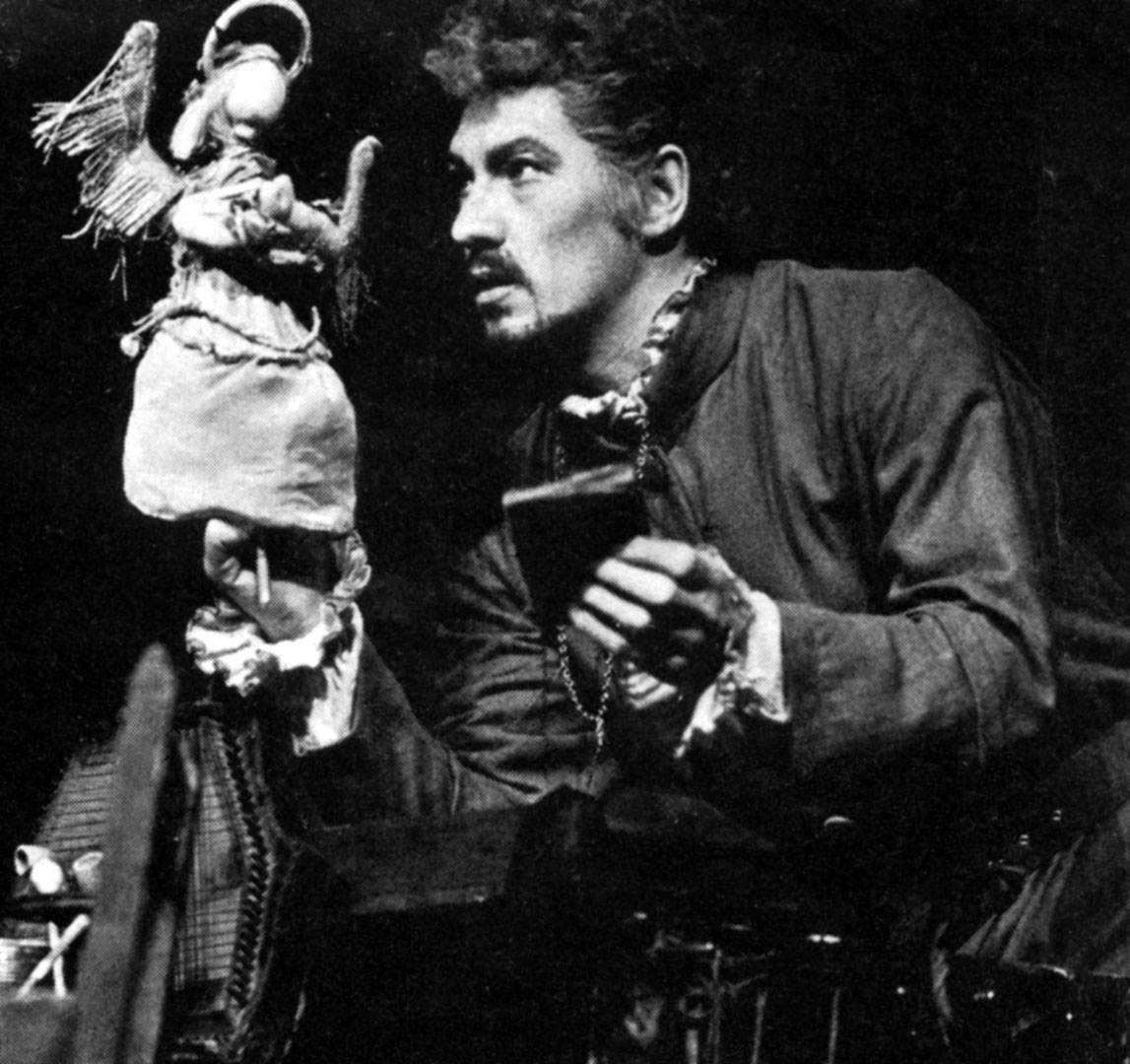
In 1974, the famous theatrical director John Barton staged [Christopher Marlowe’s] Doctor Faustus for the Royal Shakespeare Company and chose for the leading role an unknown young actor by the name of Ian McKellan. Shrewd move, that; but he made other decisions that are equally interesting and important, though from a different point of view. The directorial problem with which Barton was faced is simple yet serious: how … could we [moderns] possibly take seriously the appearance of the Good and Evil angels? And his solution was a brilliant one: he made them into hand puppets, held by Faustus himself, their lines spoken by him.
A brilliant solution on more than one count: not only does he avoid sniggers from the audience at the appearance of the debating spirits, but he simultaneously enables an understanding of Faustus that is perfectly commensurate with twentieth-century psychology. For if it was the genius of Prudentius and his followers to reach into the divided self and pull out its voices, giving them bodily substance and individual identity, it was the genius of Freud and his followers to stuff them all back into the box. When Freud sees the Good Angels and Evil Angels of our stories as projected externalizations of our own inner conflicts — puppets made by us and able to speak only through our acts of ventriloquism — he is simply returning us to the world of Augustine, in which “the devil made me do it” is scarcely a legitimate excuse. Do we sin because we heed the devilish voice in our ears? Or do we heed that voice because we have already sinned? Whatever answer we might give has little practical significance. The divided self is our inheritance no matter what, and in the pain and disorientation of that experience we may not even care whether we were torn from the inside out or the outside in.

This is going to sound terrible, but Dr. Dinosaur always reminds me of David Bentley Hart. They have similar levels of self-confidence, they often make people think that they’re crazy, and just when you’ve decided to write them off they do something strangely brilliant.
I realize that The Venn diagram of (a) people who read D B Hart and (b) people who read Atomic Robo comics has an infinitesimal intersection. But still.
“Now,” he said, swiveling his head to look at his pupils, “here is how the cycle works.” He marked off three arcs. “We have a Pelagian phase. Then we have an intermediate phase.” His chart thickened one arc, then another. “This leads into an Augustinian phase.” More thickening, and the chalk was back where it had started. “Pelphase, Interphase, Gusphase, Pelphase, Interphase, Gusphase, and so on, forever and ever. A sort of perpetual waltz. We must now consider what motive power makes the wheel turn.… In the first place, let us remind ourselves what Pelagianism stands for. A government functioning in its Pelagian phase commits itself to the belief that man is perfectible, that perfection can be achieved by his own efforts, and that the journey towards perfection is a long straight road. Man wants to be perfect. He wants to be good. The citizens of a community want to co-operate with their rulers, and so there is no real need to have devices of coercion, sanctions, which will force them to co-operate. Laws are necessary, of course, for no single individual, however good and co-operative, can have precise knowledge of the total needs of the community. Laws point the way to an emergent pattern of social perfection – they are guides. But, because of the fundamental thesis that the citizen’s desire is to behave like a good social animal, not like a selfish beast of the waste wood, it is assumed that the laws will be obeyed. Thus, the Pelagian state does not think it necessary to erect an elaborate punitive apparatus. Disobey the law and you will be told not to do it again or fined a couple of crowns. Your failure to obey does not spring from Original Sin, it’s not an essential part of the human fabric. It’s a mere flaw, something that will be shed somewhere along the road to final human perfection.… Well, then, in the Pelagian phase or Pelphase, the great liberal dream seems capable of fulfillment. The sinful aquisitive urge is lacking, brute desires are kept under rational control…. No happier form of existence can be envisaged. Remember, however,” said Tristram, in a thrilling near-whisper, “Remember that the aspiration is always some way ahead of the reality. What destroys the dream? What destroys it, eh?” He suddenly big-drummed the desk, shouting in crescendo, “Disappointment. Disappointment. DISAPPOINTMENT.” He beamed. “The governors,” he said, in a reasonable tone, “become disappointed when they find that men are not as good as they thought they were. Lapped in their dream of perfection, they are horrified when the seal is broken and they see people as they really are. It becomes necessary to try and force the citizens into goodness. The laws are reasserted, a system of enforcement of those laws is crudely and hastily knocked together. Disappointment opens up a vista of chaos. There is irrationality, there is panic. When the reason goes, the brute steps in. Brutality!” cried Tristram. The class was at last interested. “Beatings-up, secret police. Torture in brightly lighted sellers. Condemnation without trial. Finger-nails pulled out with pincers. The rack. The cold water treatment. The gouging-out of eyes. The firing squad in the cold dawn. And all this because of disappointment. The Interphase.” He smiled very kindly at his class. This class was agog for more mention of brutality. Their eyes glinted, they goggled with open mouths.
“What, sir,” ask Bellingham, “is the cold-water treatment?”
•••
“But,” went on Tristram, “the Interphase cannot, of course, last for ever.”” He contorted his face to a mask of shock. ‘Shock,’ he said. “The governors become shocked at their own excesses. They find that they have been thinking in heretical terms — the sinfulness of man rather than his inherent goodness. They relax their sanctions and the result is complete chaos. But, by this time, disappointment cannot sink any deeper. Disappointment can no longer shock the state into repressive action, and a kind of philosophical pessimism supervenes. In other words, we drift into the Augustinian phase, the Gusphase. The orthodox view presents man as a sinful creature from whom no good at all may be expected. A different dream, gentlemen, a dream which, again, outstrips the reality. It eventually appears that human social behaviour is rather better than any Augustinian pessimist has a right to expect, and so a sort of optimism begins to emerge. And so Pelagianism is reinstated. We are back in the Pelphase again. The wheel has come full circle. Any questions?”
“What do they gouge eyes out with, sir?” asked Billy Chan.
Anthony Burgess, The Wanting Seed
No doubt the spiritual and moral standards for the Christian life had relaxed quite a bit since the days of persecution, when even the hint of Christian faith could cost a person his or her life; no doubt some restored tension, some call for a renewal of holiness, was surely needed. But Pelagianism, like many zealous movements of moral and spiritual reform, writes a recipe for profound anxiety. Its original word of encouragement (You can do it!) immediately yields to the self-doubting question: “But am I doing it?” It makes a rigorous asceticism the only true Christian life — as [Peter] Brown points out, “Pelagius wanted every Christian to be a monk” — and condemns even the most determined ascetic to constant self-scrutiny, a kind of self-scrutiny that can never yield a clear acquittal. You might have missed something; and in any case you could sin in the next five minutes and watch your whole house of cards crash down.
By contrast, Augustine’s emphasis on the universal depravity of human nature — seen by so many then and now as an insult to human dignity — is curiously liberating. I once heard a preacher encourage his listeners to begin a prayer with the following words: “Lord, I am the failure that you always knew I would be.” It is the true Augustinian note. Pelagianism is a creed for heroes; but Augustine’s emphasis on original sin, and the consequent absolute dependence of every one of us on the grace of God, gives hope to the waverer, the backslider, the slacker, the putz, the schlemiel. We’re all in the same boat as Mister Holier-than-Thou over there, saved only by the grace that comes to us in Holy Baptism. Peter Brown once more: “Paradoxically, therefore, it is Augustine, with his harsh emphasis on baptism as the only way to salvation, who appears as the advocate of moral tolerance: for within the exclusive fold of the Catholic church he could find room for a whole spectrum of human failings.”
— from my Original Sin: A Cultural History; quote prompted by this essay by Elizabeth Bruenig.
Since, therefore, we see in [Jesus Christ] qualities so human that they stand in no way apart from the common weakness of mortals, and qualities so divine that they befit nothing except that highest and ineffable nature which is deity, the human intellect is seized with perplexity and so silenced with amazement that it cannot tell where to go, what to think, or where to turn. If it discerns God, what it sees is a mortal. If it thinks him a human being, what it perceives is one returning from the dead bearing the spoils of death’s conquered empire.
. . . Obviously, to set all this forth for people and explain it in speech far exceeds the power at once of our deservings, our talents, and our words. I judge, however, that it surpassed the capacity of even the holy apostles; indeed, when all is said, the explanation of this mystery may reach even beyond the whole created order of the heavenly powers.
— Origen of Alexandria, De Principiis, Book II, Chapter 6, “On the Incarnation of Christ”
Hope seizes, or rather is seized by, the promise of the future. To that extent, it is the great hope, the expectation of the eternal life, which has still to be manifested and given to us, confidence in the coming Jesus Christ as the end and new beginning of all things, the joy in anticipation of the perfect being of man and all creatures in the service of God which is pledged because it is already actualized in Him. As it seizes the promise of the future it is in every respect – not only hope which derives from Him but also hope in Him as the eternally living One. He, the content of the promise and object of hope, cannot be replaced by any other. If there is also a small hope for today and tomorrow, if there are also temporal, penultimate, provisional and detailed hopes for the immediate future, it is only because He is the future One who shows himself in every future.
Where there is the great hope, necessarily there are also small hopes for the immediate future. These hopes have their basis and strength only in the great hope. They are small, relative and conditioned. In their detailed content, they may be mistaken and open to correction. But within these limits they are genuine hopes. And it is certainly in these many little hopes that the Christian lives from day to day if he really lives in the great hope. And perhaps he is most clearly distinguished from the non-Christian by the fact that, directed to the great hope, and without any illusions, he does not fail and is never weary to love daily in these little hopes. But this necessarily means that he is daily willing and ready for the small and provisional and imperfect service of God which the immediate future will demand of him because a great and final and perfect being in the service of God is the future of the world and all men, and therefore his future also.
— Church Dogmatics IV/1, pp. 120-122
I think it’s generally known that one wing of the New Atheism, led primarily by Jerry Coyne, has made the denial of free will a major cause. Well, so have Calvinists! (Just for somewhat different reasons.) I think all aspects of the Great Free Will Debate are illuminated by this wonderful passage from Leszek Kolakowski’s magisterial book on Pascal and the Jansenist controversy, God Owes Us Nothing:
The belief that everything is preordained by God is psychologically compatible with the belief that I am free in my actions. Personal freedom is an irresistible and elementary experience; it is not analyzable any further because of its elementary character. The former belief acts as a source of trust in life: God rules and orders everything, thus everything is directed toward a good outcome, even if we cannot know or see the cunning tactics of providence. This psychological compatibility proves doubtful when exposed to theological scrutiny, and the task is then to make a coherent, logically sound whole out of the two experiences.… The most elementary facts of experience – “I,” existence, freedom – once converted into theoretical concepts, tend to resist logical examination and are therefore threatened with a verdict of theoretical annihilation; indeed, they have on many occasions been denounced as figments of the imagination. Still, they do not vanish from experience; they stubbornly refuse to evaporate, all philosophers’ condemnations notwithstanding. To accept all-embracing providence without denying the irresistible experience of freedom is psychologically possible even for people who cannot be accused of having simply failed to learn their first lesson in logic; they do not necessarily feel mental discomfort because they believe in, or experience, both. But to unite both in a consistent “theory” seems hopeless, and when theologians ultimately admit that there is a “mystery” in combining providence and freedom, they do not claim to explain anything, but accept the inadequacy of “human reason.” Rationalists normally shrug off the idea of “mystery” (as distinct from something not yet known) as a verbal cover for simple illogicality. However, when people think of ultimate realities, the experience of mystery, which often includes a logical helplessness, may be intellectually more fruitful than rationalist self-confidence that simply cancels metaphysical questions, relying on doctrinal dogmas. To be sure, we have only one logic at our disposal but we are not sure how far its validity can extend when dealing with those ultimate realities.
Lately I’ve been trying to read John Calvin, and I’m struggling. When I was in graduate school I read the whole of the Institutes, and as I recall I did so with interest and at least some profit, but now … it’s hard.
People who love Calvin often say that his thinking and theology must be clearly distinguished from the use later made of them. If certain Calvinists are dour, rigid, cold, insensitive to the human condition, prone to make vast theological generalizations from a handful of biblical passages while ignoring the greater part of the biblical witness, those vices should not be attributed retrospectively to Calvin. Which is certainly true, and something I try to keep in mind. But as I read Calvin now, I consistently find him to be dour, rigid, cold, insensitive to the human condition, and prone to make vast theological generalizations from a handful of biblical passages while ignoring the greater part of the biblical witness.
I am not at all sure I’m being fair to Calvin. I would like to think that as I get older I become a better reader, because I know more and have more experience. (Don’t we all like to think that of ourselves?) But experience is a two-edged sword. In the decades since I first read the Institutes I’ve had a great deal of experience with Calvinists, or people who claim to be Calvinists, and with some notable exceptions it hasn’t been pleasant. (In general, and for whatever reason or set of reasons, I found the Calvinists I met at Calvin College far more generous and humane — far more attuned to the spirit of Christ, at least as I discern it — than the Calvinists I met at Wheaton College. And in an environment that’s not wholly Calvinist, self-consciously Calvinist undergrads can be enormously troublesome, because they believe, and tell everyone who will listen, that they and they alone have the honesty and courage to face the hard truths of the Bible….)
But I digress. The point today is that I am simply unable to isolate my reading of Calvin from those several decades of experience (both in person and in reading) with people who admire and see themselves as followers of Calvin. It is possible that this background is actually helpful: for instance, perhaps if generations of readers have discerned certain implications in Calvin’s work, then they’ve seen something that’s really there, for good or ill, and I would do well to be attentive to it. But it seems to me more likely that Calvin’s successors, being less gifted than he, are drawing less subtle and nuanced conclusions than he did. And if that is the case, then my years of experience may be making me a less successful reader of Calvin than I was thirty years ago — at least in certain ways. (What I’ve learned about theology and church history in the intervening years has to be worth something.)
In any event, as I read I keep telling myself read this as though it’s new to you, as though you have no idea who John Calvin is — but it’s not working very well. I find myself longing to turn to Thomas Aquinas, whom I find infinitely more simpatico. But I shall persevere — both in reading Calvin and in trying to understand what it means to be a good reader.
Another photo from that NYT story on the restoration of the Ghent Altarpiece. I have long dreamed of writing a comprehensive theology of culture — one to replace Richard Niebuhr’s overrated and conceptually rigid Christ and Culture, one founded in a truly thick theological anthropology, one that reckons with the full inheritance of modernity. So, so much of what I would want to say in such a book is already said by this image.
God’s gift at Christmas is relationship, not just another human relationship but relation to God the Father by standing where Jesus stands, standing in the full torrent of his love and creativity, giving and receiving. To come into that place and to be rooted and grounded there means letting go of our fear of dependence and opening our hearts to be fed and enlarged and transformed. And that in turn means looking at how we handle dependence in ourselves and others, how we accept the positive dependence involved in lifelong learning and growing, and help one another deal with it positively.
So the important thing is not that everyone gets to stand on their own two feet and turns into a reliable “independent” consumer and contributor to the GNP. What we expect from each other in a generous and grown-up society is much more to do with all of us learning how to ask from each other, how to receive from each other, how to depend on the generosity of those who love us and stand alongside us. And that again means a particular care for those who need us most, who need us to secure their place and guarantee that there is nourishment and stability for them.
Steve Holmes recently wrote of his experience defending the traditionalist view on homosexuality at the Society for Biblical Literature conference:
I was slow to understand what went on in our session at ETS; the Rottweilers were out in some force, and challenging Megan and Bill [who were arguing for affirming same-sex relationships] on their understanding… But there was repeatedly an extra step stated or implied in the questions, from ‘this is wrong’ to ‘you are not a Christian’. I admit I did not understand where this was coming from.
Then someone came up to me at the end, and asked why I had been defending my friends. I began to say some stuff about love and loyalty but he cut across me, ‘They are leading people onto the highway to hell!’
I’ll set aside my difficulties with serious use of the phrase “highway to hell” in our post-AC/DC era, and just note that I have heard this before from my fellow theological conservatives: that people who teach that same-sex unions can be affirmed are not just wrong but are “false teachers” — people teaching something clearly other than the Gospel of Jesus Christ, and therefore to be denounced and cast out rather than treated as brothers and sisters with whom we disagree.
I think this is the wrong way to look at the situation and want to explain why. (Let me also add that I affirm with my whole heart the rest of Holmes’s post, and his further reflections in the comments thereupon. The affirmations I share with him are useful context for my views on this particular matter.)
Let’s begin by positing a few assumptions, because the argument I want to explore only arises when the following assumptions are granted: (1) that the Church must, in order to carry out its mission, confront theological and moral error; (2) that Holy Scripture is our authoritative guide to theological and moral truth and falsehood; (3) that sexual behavior is taken very seriously throughout the NT and that erroneous teaching about it must therefore be seen as profoundly consequential; (4) that the traditionalist side is correct on the merits, and the affirming side incorrect; (5) that there really are “false teachers” whose message is something other than the Gospel of Jesus Christ.
And perhaps one other assumption should be noted as well: that it is our place to decide who the false teachers are and to denounce them, something I have raised questions about here.
Now: onward.
As far as I can tell the two passages that are foundational for the concept of the “false teacher” are 2 Peter 2 and 1 Timothy 4. I assume that Peter’s pseudodidaskaloi are pretty much the same as Paul’s didaskaliais daimoniōn, though perhaps the latter are even worse. That is, we could have three categories of error (teachers who are sometimes wrong, false teachers, demonic teachers) — but I suspect there are just two, and the latter two categories should be seen as one.
It is interesting, I note in passing, that 2 Peter coins pseudodidaskaloi by explicit analogy to pseudoprophētai, the latter being a far more common term in the NT. But clearly false teaching and false prophecy are distinct things, though if what I say in my previous paragraph is right they have a common origin: didaskaliais daimoniōn would also be anolagous to prophētai daimoniōn.
In any case, all this is foundational to a NT anatomy of error, it seems to me.
So — setting aside as irrelevant to this canonically-based inquiry the question of whether Peter wrote 2 Peter — let’s look at the famous dispute between Peter and Paul about the “circumcision party.” Paul says he told Peter to his face that he was wrong about this, and of course Paul’s view won out at the Council of Jerusalem (where, I have always thought comically, Peter presents it as his own view, with no reference to Paul having corrected him). Now, clearly, this is a foundational issue in relation to the Gospel of Jesus Christ, and if the circumcision party had won out it would have been the death of the Church in its infancy. So it is scarcely possible for Peter, assuming that he did at one time hold this view, to have been more catastrophically wrong. Does this then mean that for a time Peter was one of the pseudodidaskaloi?
That’s not quite what Paul says when describing the disagreement in Galatians 2. Instead, he says that in the circumcision party there was a failure to “walk correctly” (orthopodousin) in relation to “the truth of the Gospel.” A fascinating turn of phrase. Here interpreters will surely differ, but it seems to me that Paul is not treating Peter as a false teacher, but rather a brother, even though a brother who has made a terrible error — for if Peter is right, the conclusion of Paul’s argument says in verse 21, then “Christ died for nothing.” Paul does not anathematize Peter, but strives to correct him as one apostle to another, not questioning his place as one of the “acknowledged pillars” (v. 9) of the Church.
So perhaps the pseudodidaskaloi and didaskaliais daimoniōn are going further and questioning or denying the most elementary and foundational teaching of all: that Jesus is Lord, according to the Christology of John 1 and Colossians 1:15–20. This would be supported, I think, by the description of the false teachers in 2 Peter: they have “licentious ways,” “destructive opinions,” and “deceptive words,” none of which are spelled out except to say that “they will even deny the Master who bought them” — which may give us some hint about how deep the errors are here and therefore what qualifies as pseudodidaskaloi. Peter, by contrast, was not — not any longer, after his shameful behavior on the night Jesus was taken away! — denying the Master who bought him, but was mistaken about what the saving power of that Master meant for the Mosaic law.
So if you can be as wrong as Peter was about something foundational for the Gospel and still not be denounced as a false teacher, then I think it follows that if people do not “walk correctly” in relation to biblical teaching about sexuality, they likewise need not be treated as pseudodidaskaloi but can be seen as brothers and sisters whom those who hold the traditional view patiently strive to correct, without coming out from among them, speaking with the patience and gentleness commended in 2 Timothy 3:24–25.
In one of his posts on the possibility of a Benedict Option for Christians, Rod Dreher made a really, really important point:
This is not the fault of mainstream culture. This is the fault of the church. We have done a dismal job preparing our kids, and preparing ourselves, for the postmodern, post-Christian world in which we live. We have to do better — a lot better. These are not normal times. Once the faith departs, it’s very hard to recover it.
I have two points to make about these sentences, one brief and one long and complicated.
The brief one: in response to Rod’s statement that “these are not normal times,” a number of people have said that these are too normal times, or that these are pretty good times for Christians, or that the times are never normal for Christians. Any or all of these may be true, and there could still be the need for a Benedict Option — because whatever it is we’re doing clearly isn’t working very well. Even the Christians who do the best job of making their communities attractive for both longtimers and newcomers aren’t succeeding by any reasonable standard of communal health. So “normal times” or not, it’s time to rethink our standard practices in the hope of genuinely thriving.
And now to the long one. I want to describe a case study in pastoral care, in the Episcopal Church. It involves a gay married couple in Orlando who want to have their child baptized but have met resistance from those who believe that the couple is disobedient to classic Christian teaching about sexuality and therefore cannot really affirm the whole Baptismal Covenant. For instance — so the argument goes, as I have heard from people closer to the situation than I am — those who are openly living in sexual sin cannot honestly answer “Yes” to the question, “Will you persevere in resisting evil, and, whenever you fall into sin, repent and return to the Lord?”
I think that child in Orlando should have be baptized (and indeed, eventually he was). I’d like now to spell out my reasons, in a way that would also suggest a Eucharistic theology.
My understanding of the sacraments of Holy Baptism and Holy Communion, which I take to be a standard (if not the only standard) Anglican understanding, is that they are not just signs but means of grace: “spiritual food and drink,” as is said in the prayer book. It is by and through the sacraments that we are enlightened and empowered to be the body of Christ in and for the world. And of course it is only through the sacrament of Baptism, in which we die along with Christ, paying the due penalty for our sin, and are then raised to new life in Him, that we are so reconciled with Him that we may participate in the sacrament of Holy Communion. And as John Wesley wrote, “The chief of these means [of God’s grace to us] are prayer, whether in secret or with the great congregation; searching the Scriptures; (which implies reading, hearing, and meditating thereon;) and receiving the Lord’s Supper, eating bread and drinking wine in remembrance of Him: And these we believe to be ordained of God, as the ordinary channels of conveying his grace to the souls of men.”
Therefore to deny people the sacraments is to deny them one of the primary means by which they can receive the enlightening and empowering grace by which they can come to know God and follow Him. For the Anglican with a high sacramental theology, it is to deprive them of the “spiritual food and drink” that should be our regular diet. This strikes me as a massively dangerous thing to do. How can we expect people to think as they should and act as they should if we are denying them access to this empowering grace? If we could think and act as mature Christians without regular access to the sacraments, then what need do we have for those sacraments?
So on what grounds might one deny Holy Baptism to that child in Orlando?
I presume the argument is a prudential one based on church discipline: People who openly disobey the Church’s moral teachings cannot be given the sacraments until they repent and promise to alter their ways. To do otherwise is to empty out the authority of those teachings. I don’t think that’s a strong argument for several reasons:
- It is extremely unlikely that any of the people involved have been well-catechized in the Faith. We all need to face up to the fact that almost no churches in the Anglican tradition, conservative as well as liberal, have taken catechesis seriously for a long time. To deny the sacraments to people the Church has failed to catechize is to make others suffer for the failings of the Church’s leadership.
- Almost everyone in our society — with the exception of monastics, the Amish, and a few fundamentalist Protestants — has been deeply and persistently catechized by the mass media into a very different model of sexuality than the Christian and biblical one. We should have the same compassion for them as we would for people who have been raised in a brainwashing cult.
- I cannot see the justice or lovingness of denying a child the sacrament of initiation into Christ’s body because of any shortcomings of his or her parents, especially if those parents have not themselves been well-catechized. Not only is the child being denied initiation, but the congregation is being denied the sacramental task of praying that child into full Christian faith. (Some may say, “Well, they can pray anyway” — which they can: but if that’s the whole response, then what good is Baptism? In my understanding, it is the wedding garment that allows entry to the Great Feast; the person who lacks it is in a dangerous place, and even the prayers of the faithful cannot wholly compensate for that lack.)
- Moreover, even in cases where church discipline is called for, the denial of the sacraments is the “nuclear option” of discipline — the most severe penalty a church can administer. This seems to be wholly out of proportion to the sins involved.
- The model of Jesus is here, as everywhere, vital: the man who scandalized the Pharisees because of his willingness to have fellowship, indeed table fellowship, with sinners. We should remember that Jesus did not say to Zaccheus, “Repent and I will come to your house tonight.” Rather, his determination to sit at table with Zaccheus was what prompted Zaccheus’s repentance.
My concern here is that Anglican leaders whose theological instincts are sound and good, who feel the enormous pressure by our society (including many in the Church) to alter ancient Christian teaching to suit contemporary preferences, are allowing their pastoral theology and pastoral practice to be warped by these controversies. We are surrounded by sexual revolutionaries who insist that sexuality is fundamental to identity, is the most important thing imaginable — and in order to resist them we end up agreeing with them, and elevating disputes on sexuality to a level of importance which properly speaking only should belong to credal questions.
Let me be clear: I am not saying that sexuality is something that Christians can “agree to disagree” about — it is too important for that, affects too many lives too profoundly — but rather that our disagreements on these issues should not lead to the “nuclear option” of denying people the sacraments. (I would note that questions surrounding what Christians do with their money are just as important, and in historical terms even more contested, and yet never lead to the denial of sacramental participation.)
To put the matter briefly and bluntly: I fear that in rightly attempting to “hold the line” on sexuality we are in serious danger of allowing something very close to a Donatist spirit to creep into our pastoral theology and practice. And I think this is very dangerous indeed — dangerous to us and to the people whom we would deny sacramental participation. We cannot stress too strongly, it seems to me, that none of us is worthy so much as to gather up the crumbs from under the Lord’s Table. And we should remember that the task of re-catechizing the Church is going to take a very long time — decades, perhaps centuries — and in the meantime we must be generous and loving to those who have been brainwashed by the world, and not prevent those who desire it from taking the true spiritual food and drink on which we were meant to live. As Bernard of Clairvaux wrote, “Honor and glory belong to God alone, but God will receive neither if they are not sweetened with the honey of love.”
For some time now I’ve had reflections on theological and pastoral controversies — some in the Anglican world, some the evangelical, some in both — sitting on my hard drive. I’ve decided to post three of them, not so much because I’m sure they’re all right, but rather in the hope that I can cease to chew these issues over and move on to other things. This is the first of my three bleats.
Anglican practices of Communion have historically been quite variable, with different parishes in different regions at different times choosing to make Holy Communion or Morning Prayer the usual Sunday morning service. But the conditions for admission to Communion have not varied so much. Typically, people baptized in the name of the Holy Trinity who are not “notorious evil livers” and who are at peace with their neighbors are eligible. When there has been a practice of Confirmation — not universal among Anglicans — then that may also have been a condition, though more recently it has been left to the discretion of parents to decide whether to have their children come to the Communion rail.
I might add that when Confirmation has been a prerequisite for Communion, that Confirmation has often been connected to the brief and beautiful catechism of the 1662 BCP, with its elegant invocation of three central texts of Eucharistic and daily worship: the Creed, the Decalogue, and the Lord’s Prayer.
Communion practices are a useful point of focus to explore a development that concerns me greatly: what looks to me like the abandonment, among all varieties of North American Anglicans, of certain longstanding Anglican practices.
Before I go any further, let me pause to note that I have no stature to debate these matters. I am neither a bishop nor a priest not a biblical scholar nor a liturgist nor a theologian. I am just a layman of some years’ standing — one of the sheep. But, as C.S. Lewis said in his great essay on “Modern Theology and Biblical Criticism,” a sheep at least can bleat. Consider what follows as my bleat.
When an Anglican complains about the abandonment of longstanding practices, he or she usually has the Episcopal Church (TEC) in mind. And indeed many TEC parishes and dioceses have been jettisoning their Anglican, and more generally Christian, inheritance as fast they can manage. One of the key abandonments here has been ceasing to make Trinitarian Baptism a prerequisite for admission to the Lord’s table, and I can’t imagine a more thoroughgoing practical rejection of the Christian message than open Communion. For, if the traditional view is that Baptism is the sacrament of reconciliation and Communion the sacrament of the reconciled, open Communion effectively denies that we need to be reconciled to God: God is perfectly happy with all of already, so — in defiance of the parable of the Wedding Feast — we’re all automatically welcome at His table, wedding garment be damned.
But I fear that ACNA, or at least some of the parishes and dioceses of ACNA, in their eagerness to differentiate themselves from TEC, have also set aside Anglican tradition, just in an opposite way. I live in Waco, Texas, which places me in ACNA’s Diocese of Forth Worth, and this diocese will admit to Holy Communion only those baptized Christians who affirm the Real Presence of Christ in the Eucharist.
Now, the teaching of the Real Presence is a strong element in Anglican theology since Hooker, and something that I affirm with all my heart and soul and mind; but to make it a requirement for admission to the Eucharistic feast strikes me as just as un-Anglican as open Communion. Affirmation of the Real Presence is not even in the Articles of Religion, and those were meant to be binding only on ordained clergy. To ask ordinary laypeople to make affirmation that priests were historically never required to make, or else bar them from the great meal of the Church, seems to me indefensible from any historically Anglican point of view. (And I am setting aside the question of whether apprehension of the Real Presence is actually possible outside the experience of its benefits. That Christ is truly present in the sacrament is indeed a truth-claim, but not one that we apprehend in the same way that we apprehend that 2+2=4. But again, we can set that aside for now.) And, equally, to deny that meal to faithful and validly-baptized Christians from traditions that do not acknowledge the Real Presence strikes me as a massive failure of hospitality in one of its most important senses. St. Paul’s notion of the “household of faith” (Gal. 6:10) seems immensely relevant here.
Presumably the exegetical defense here would be that those faithful Baptists and other are “those who eat and drink without discerning the body of Christ” (1 Cor. 11:29). But to make access to Communion contingent on holding a particular interpretation of a single extremely obscure verse is surely un-Anglican at best — especially since so many not qualify under this particular interpretation. Could Richard Hooker — who wrote “The real presence of Christ’s most blessed body and blood is not to be sought for in the sacrament, but in the worthy receiver of the sacrament” — receive Communion in the diocese of Fort Worth? Could Jeremy Taylor? (“CHRIST is present in the Sacrament to our spirits only, i.e. not present to any other sense but that of faith.”) Could John Stott?
It might be objected that this is a diocesan mandate, not a more broadly denominational one. But that is a very large part of the problem. On an essential matter of the basic practice of the church — essential especially in our age, in which Communion is offered at least weekly and perhaps more frequently than that — a bishop can be dictatorial while the denomination as a whole remains agnostic. (By a similar logic though in a different venue, ACNA priests have the option in their parishes to remove the filioque from the creed. The filioque, about which there have been such bitter and tragic disputes over the centuries, reduced to a parish-level decision — as though it is pure adiaphora!)
I have noted that there are historic relations that link admission to Communion with Confirmation and Confirmation with a Catechism. ACNA is equally Janus-faced about this matter as well. In what the chair of the Catechism Committee, J.I. Packer, admits is a deviation from Anglican tradition, To Be a Christian: An Anglican Catechism is longer, more detailed, and more complex than its predecessors. This, Packer says, is because the new document “is intended as a more comprehensive catechetical tool” to be used in a variety of instructional contexts. In general, the new catechism is well-made, though sometimes it inadvertently gets into disputed or ambiguous territory. For instance, when it says that “when the Lord Jesus Christ returns, the world as we know it will come to an end,” that is only accurate under certain meanings of “as we know it” and “come to an end.” Which makes me wonder whether this is a matter that belongs in a Catechism.
That, however, is not a question I can answer without having a better understanding of how the Catechism is to be used, and that’s hard to tell from the document itself. In his prefatory letter, Archbishop Bob Duncan says that “the degree to which it is used directly for instruction, and the amount of memorization asked of individual catechumens, is left up to the catechist to determine by context and circumstance.” It seems, then, that Archbishop Duncan does see this catechism as an element of preparation for Confirmation — but perhaps only if individual priests choose to use it? It’s hard to tell. And of course nothing is here said about the link between Confirmation and admission to Communion.
So on the one hand ACNA clearly wants to be more rigorous than TEC, not to make the parent denomination’s mistakes again; but, like so many children who rebel, it ends up replicating some of the problematic tendencies of the previous generation. Here’s a detailed and specific Catechism — but only use it when you want to, and in the way you want. Being a faithful baptized believer in the Gospel of Jesus Christ is enough to get you welcomed to the Eucharistic feast — well, in many dioceses, anyway. Parish priests may add or subtract the filioque at will. There is the appearance of rigor but, on the diocesan and sometimes the parish level, about as much of a choose-your-own-adventure model as there is in TEC.
In the Anglican way at its best, affirmations, expectations, and definitions are kept clear, minimal, and firm. That’s why my favorite Anglican documents are the 1662 Catechism and the Lambeth Quadrilateral. When TEC showed itself unwilling or unable to enforce even the most minimal commitments for belief and practice, ACNA responded with a series of expanded rubrics and statements — most of which are made optional and therefore lack power to compel and unify. Given that ACNA is trying to hold together a diverse constituency, this may be understandable. But that is of little comfort to the poor confused sheep bleating from the pews.
It seems clear to me that the one thing the clergy of ACNA have been able to agree on is that they want to avoid the wishy-washiness that emptied out the doctrine (and the pews!) of TEC. They concluded that in order to avoid such a fate they needed to make their own affirmations more specific and more detailed. But they have not so far been able to agree on what those more detailed statements must be. So increased strictnesses are put on the table — but only as options, at either the diocesan or the parish level.
I am inclined to think that this approach was bound to fail and indeed was misbegotten. The problem with the TEC isn’t that there aren’t enough rules, or sufficiently specific ones, but that the existing rules are so often flouted. Parishes opened Communion and ceased to be bound in their public readings by the lectionaries, or even the Bible. Bishops openly defied the doctrine and discipline of the church they had pledged to defend.
Is it too late for ACNA to rethink all this? I fear it is. But still, I plead: be brief, be blunt, be straightforward. Tell us what the Nicene Creed is, without offering substitutions on the menu. Keep the requirements for admission to the Lord’s Table minimal but clear, and police them firmly. (Remember that this is the “spiritual food and drink” on which the followers of Jesus are meant to feed, and that we do not function as well when we lack access to it.) Beware of extraneous forms of strictness, especially if they’re only optional. Be willing to sacrifice some of your own preferences in order to bring peace and understanding to your sheep. Such rules and disciplines as are formulated, obey. In non-essentials let there be liberty, in essentials unity, in all things charity … and in a great many more things clarity.
Here endeth the bleat. Those of you who can instruct and correct me, please do so.
It is not enough for a population or a section of the population to have Christian faith and be docile to the ministers of religion in order to be in a position properly to judge political matters. If this population has no political experience, no taste for seeing clearly for itself nor a tradition of initiative and critical judgment, its position with respect to politics grows more complicated, for nothing is easier for political counterfeiters than to exploit good principles for purposes of deception, and nothing is more disastrous than good principles badly applied. And moreover nothing is easier for human weakness than to merge religion with prejudices of race, family or class, collective hatreds, passions of a clan and political phantoms which compensate for the rigors of individual discipline in a pious but insufficiently purified soul. Politics deal with matters and interests of the world and they depend upon passions natural to man and upon reason. But the point I wish to make here is that without goodness, love and charity, all that is best in us—even divine faith, but passions and reason much more so—turns in our hands to an unhappy use. The point is that right political experience cannot develop in people unless passions and reason are oriented by a solid basis of collective virtues, by faith and honor and thirst for justice. The point is that, without the evangelical instinct and the spiritual potential of a living Christianity, political judgment and political experience are ill protected against the illusions of selfishness and fear; without courage, compassion for mankind and the spirit of sacrifice, the ever-thwarted advance toward an historical ideal of generosity and fraternity is not conceivable.
— Jacques Maritain, Christianity and Democracy, 1944 (emphasis added)
But of all the marvellous and mighty acts related of Him, this altogether surpasses human admiration, and is beyond the power of mortal frailness to understand or feel, how that mighty power of divine majesty, that very Word of the Father, and that very wisdom of God, in which were created all things, visible and invisible, can be believed to have existed within the limits of that man who appeared in Judea; nay, that the Wisdom of God can have entered the womb of a woman, and have been born an infant, and have uttered wailings like the cries of little children! … Since, then, we see in Him some things so human that they appear to differ in no respect from the common frailty of mortals, and some things so divine that they can appropriately belong to nothing else than to the primal and ineffable nature of Deity, the narrowness of human understanding can find no outlet; but, overcome with the amazement of a mighty admiration, knows not whither to withdraw, or what to take hold of, or whither to turn. If it think of a God, it sees a mortal; if it think of a man, it beholds Him returning from the grave, after overthrowing the empire of death, laden with its spoils. And therefore the spectacle is to be contemplated with all fear and reverence, that the truth of both natures may be clearly shown to exist in one and the same Being; so that nothing unworthy or unbecoming may be perceived in that divine and ineffable substance, nor yet those things which were done be supposed to be the illusions of imaginary appearances. To utter these things in human ears, and to explain them in words, far surpasses the powers either of our rank, or of our intellect and language. I think that it surpasses the power even of the holy apostles; nay, the explanation of that mystery may perhaps be beyond the grasp of the entire creation of celestial powers.
Today is the Feast of Saints Basil & Gregory Nazianzen, which reminds me that some years ago I wanted to write a book for the church that took the Cappadocians as our models. I never got beyond the proposal, in part because the editors I talked to weren’t enthusiastic; my idea seemed neither fish nor fowl, too churchy for an intellectual audience and too intellectual for a churchy audience. So I set the idea aside and am not likely, now, to return to it. In lieu of that I’m posting the proposal here.
Heroes. One of my heroes is Paul Farmer. Farmer is a physician who teaches at Harvard, co-edits a journal called Health and Human Rights, and leads an organization he founded called Partners in Health. That last role leads him to spend much of his time in Haiti, Rwanda, and other parts of the world where health care for the poor has traditionally been poor or nonexistent. For a couple of decades now Paul Farmer has done as much as anyone in the world to save the lives of people whom the world in general thinks not worth saving. And key to his devotion is his lifelong Catholic Christian faith.
I have other heroes. Some of them work for Care Net, an organization founded in 1975 by evangelical Christians to provide pregnant women with alternatives to abortion — and to provide counseling and compassionate attention to women who have had abortions. The people of Care Net also share the good news of the Christian gospel with the women whom they serve.
I have at times been in groups of people who know and respect the work of Care Net, but if in those contexts I mention my admiration for the work of Paul Farmer and Partners in Health, I am liable to get some suspicious looks. Paul Farmer’s theology is on the liberal end of the spectrum, as are his politics: for instance, he is a vocal admirer of the Cuban government’s health care system. He has had a book written about him by Tracy Kidder, also a political liberal and a thoroughly secular writer; Sixty Minutes, even, has done an admiring segment on him. He’s the liberal elite’s ideal do-gooder. What does that have to do with Christianity?
In other groups, people join enthusiastically in my praise for Paul Farmer — but become nervous when I mention my admiration for Care Net. They hear of an organization trying to provide women with alternatives to abortion and they think of large photographs of bloody fetuses held aloft by abortion-clinic protestors; they think of reactionaries who want to control women’s bodies and keep them barefoot and pregnant; they think of a conservative evangelical church in thrall to the Republican Party. If they saw the institutional history Care Net provides on its website they would be even more worried: “Care Net was influenced by the evangelical leadership of former U.S. Surgeon General Dr. C. Everett Koop and Christian apologist, Dr. Francis Schaeffer.”
And yet both Partners in Health and Care Net are pursuing the Biblical mandate to care for the weakest and most helpless among us. In so many ways they are doing the same work, and even are dedicated to the same goal — the preservation and healing of the lives of people made in the image of God. Why must we see them in opposition to each other? (And for all I know they may even see themselves in opposition to each other.) Such an attitude is simply tragic.
And the cause of the tragedy is this: that the categories of American politics determine the way that many American Christians think about ministry, mission, and service. The talking points and platform statements of the two major political parties provide the guidelines that many Christians use to judge things of the Gospel. Simply put, many American Christians have been intellectually formed by our political debates — especially as they are digested and interpreted on television news programs — far more than by immersion in Scripture or the great movements and figures of Christian tradition.
There have of course been attempts to bridge this political gap, primarily through Catholic social teaching. The late Joseph Cardinal Bernadin of Chicago was particularly associated with the notion of the “seamless garment” of life, the necessarily interwoven character of all attempts to promote human survival and human flourishing. Others have adopted the phrase “consistent life ethic” to indicate much the same emphasis. But often these voices have been ignored because they have been perceived as coming from a particular “side” in the already-existing political debate. (Similar criticisms have been directed against Jim Wallis’s God’s Politics: many a reviewer has commented that God’s politics seems to be indistinguishable from that of recent Democratic Party platforms.) Moreover, these movements tend to be grounded very specifically in Catholic theology, in ways that can be daunting or confusing for people who do not know that tradition well.
What is needed at this moment is a way of approaching these immensely complex yet utterly essential issues that evades our usual and comfortable political categories. We need to be taken out of our own time and place, so that we might see what a real Gospel of Life looks like to Christians who didn’t look much like us, think much like us, or live much like us. We need to travel to Cappadocia during the time of the Church Fathers. There we will find one family who, among themselves, practiced the Gospel of Life in all its fullness.
The Cappadocians. Cappadocia is a region in what is now central Turkey. In the time with which we are concerned, it was an economically and culturally vibrant place. To the north is the district of Pontus and the Black Sea. To the west are the shores of Asia Minor, then dotted with great cities — Ephesus particularly well known to us because of Paul’s visit and letter to the churches there. Due south one would have found Tarsus, Paul’s home town, whose great Mediterranean harbor was even then silting up and landlocking it. To the southeast is Palestine. In the late Roman world, Cappadocia was a great crossroads.
Sometime around the year 270, probably in the Pontus region, a woman was born named Macrina. Later she married — we don’t know her husband’s name — and had children. She was a faithful Christian, which it was not good to be in that time and place, for in the year 303, when Macrina’s son Basil would have been around eight years old, the Roman Emperor Diocletian and his colleagues Maximian, Galerius, and Constantius began issuing a series of repressive edicts aimed directly at the Christians of the empire. Eusebius, the great historian of the early church, who was around forty when the persecutions began, described the situation in this way:
This was the nineteenth year of the reign of Diocletian, in March, when the feast of the Saviour’s passion was near at hand, and royal edicts were published everywhere commanding that the churches should be razed to the ground, the Scriptures destroyed by fire, those who held positions of honor degraded, and the household servants, if they persisted in the Christian profession, be deprived of their liberty.
And such was the first decree against us. But issuing other decrees not long after, the Emperor commanded that all the rulers of the churches in every place should be first put in prison and afterwards compelled by every device to offer sacrifice [to the old Roman gods]. Elsewhere in the Empire, particularly in the far west and north, these edicts were enforced half-heartedly or not at all; but in Cappadocia and Pontus the officials pursued Christians with real, and frightening, enthusiasm. Macrina and her family fled into the countryside, probably to the shores of the Black Sea, and waited out the persecutions.
The attempts to suppress Christianity waned over the next few years and were officially ended in 313, when Constantine the Great and his co-emperor Licinius issued the Edict of Milan, which guaranteed religious freedom for Christians. Pontus and Cappadocia were safe again, and Macrina raised her children in the Pontine city of Neocaeserea. Later her son Basil would marry a devout Christian woman named Emmelia — her father had been martyred in the persecutions — and move to Ceasarea, which would become the center of this family’s life. Basil established himself as a teacher of rhetoric and, more important, a lay teacher of the Christian faith, celebrated throughout the city for his wisdom and piety.
Basil the Elder, as he came to be known, and Emmelia went on to have ten children. We know the names of five of them: Macrina, Basil, Gregory, Naucratius, and Peter. We know those five names because all of them became recognized as saints of the church — as did Basil the Elder, Emmelia, and the matriarch Macrina the Elder.
Let us pause to contemplate this for a moment: one family; three generations; eight saints.
What did these people do to earn such lasting fame and praise? Here I will offer just a brief account:
- Macrina the Elder was canonized for her faithfulness in time of persecution;
- Basil the Elder for his powerful and influential teaching;
- Emmelia largely for the extraordinary family she raised, though she may also have had an active role in the ministries of some of her children;
- Macrina the Younger for her teaching of her younger siblings, and as the founder of a community for widows, abandoned women, and orphans;
- Basil, later Basil the Great, for his work as priest, bishop, scholar, defender of Trinitarian orthodoxy, champion of the poor and hungry, and founder of the Basileion, the first Christian hospital;
- Gregory, later Gregory of Nyssa, for much the same work as his older brother Basil did, though on slightly less titanic a scale;
- Naucratius, for his holy life as a hermit and as a servant of, especially, the elderly poor;
- Peter, later Peter of Sebaste, for his work as priest, monk, bishop, defender of Trinitarian orthodoxy, and as partner with his sister Macrina on behalf of the poor.
It’s all really quite overwhelming, and, when related in detail (as this book will do), deeply moving and encouraging. What’s especially noteworthy for anyone interested in the Gospel of Life is how seamless the family’s garment of service is. This can be seen with particular clarity in the career of Basil, who moved so easily from advocating for the poor in the pulpit to building the first hospital to combatting Arianism and other heresies of the time. It was one Gospel to him — and, I think, to the rest of his family — one unified model of human flourishing in Christ.
In order to understand why the way of life offered by this single Cappadocian family is so important an example for us, we might turn to the thirty-fourth chapter of the book of the prophet Ezekiel. Here Ezekiel is lamenting the circumstances that led to the collapse of Israel and the carrying off of its people, including Ezekiel himself, into captivity in Babylon. The fault, he says — or the Lord says through him — lies with the “shepherds,” the elders of Israel. The Lord denounces the shepherds thus:
The weak you have not strengthened, the sick you have not healed, the injured you have not bound up, the strayed you have not brought back, the lost you have not sought, and with force and harshness you have ruled them. So they were scattered, because there was no shepherd, and they became food for all the wild beasts. . . . My sheep were scattered over all the face of the earth, with none to search or seek for them.
Several things are noteworthy about this passage: the powerful condemnation of sins of omission, for which most of us tend to excuse ourselves; the opposition of ruling “in force and harshness” — domination — to compassionate care; and especially the bringing together of very different forms of suffering.
There are five categories of sufferers in this passage: the weak, the sick, the injured, the strayed, and the lost. It’s pretty clear that the first three apply in equally literal ways to sheep and to people: the Lord is accusing the elders of Israel of neglecting the physical sufferings of the people. But the remaining two categories have an equally clear metaphorical meaning when applied to people, as they do throughout the prophets (“All we like sheep have gone astray”). The Lord clearly says that the elders of the nation have neglected the spiritual as well as the physical needs of the people — they have been shamefully negligent across the board, obsessed instead with maintaining their own power to rule.
The behavior of the shepherds of Israel is a lamentable inversion, then, of the gospel that our Cappadocian family practiced. What the shepherds “did not” the Cappadocians did, like the two groups Jesus contrasts to each other (“those on his right” and “those on his left”) in Matthew 25, a passage that strongly echoes Ezekiel 34. It is by striving to see ourselves in these two distant mirrors — and not by situating ourselves or others on today’s American political map — that we 21st-century Christians can find our proper roles in Christ’s Kingdom, can find the genuine Gospel of Life.
I plan to narrate the story of this great Cappadocian family immediately after the book’s introduction (which will say in more detail many of the things I say in the opening paragraphs of this proposal). The family’s story is a powerful one, and will provide a host of examples that I can draw on throughout the book.
The Image of God. The next stage will start from a question: What was the biblical-theological model that our Cappadocian family was living out? What were their key principles, their core convictions? (Note that for us, as for Basil and his fellow Catholic bishops, sound orthodox theology and reverence for Scripture are indispensable to our lives in the Kingdom, and properly inseparable from the kind of work usually called “social ministry” or “compassionate ministry” — as though it is neither social nor compassionate to preach to all the story of Christ crucified.) My answer will follow a sequence of propositions that follow from the belief that all of us are made in the image of God. As Gregory of Nazianzus said in his great sermon “On the Love of the Poor,” “Do not despise those who are stretched out on the ground as if they merit no respect…. They bear the countenance of our Savior.”
- To be made in the image of God is to have dominion over creation.
- To be made in the image of God is to be in communion with God and with one another.
- Because we are fallen beings, the image of God is defaced in us, but it is not erased. We still show it imperfectly.
- We sin against the image of God in our neighbors when we fail to see that “they bear the countenance of our Savior,” and try to exert dominion over them instead of embracing communion.
- To follow Christ, to live in him and be conformed to his image, is to have the image of God in us restored.
- We are made in the image of God and yet — sometimes because of sin and sometimes because of the variety of created beings — we are all in some sense weak.
- The Biblical picture of God centers on his compassion for all forms of human weakness.
- Insofar as we are conformed to the image of Christ, we too will exhibit that compassion for weakness.
- And we will do so all the more because we too experience weakness and hope that people who are stronger will have compassion on us.
- To be in communion with one another is to give and receive help appropriate to our weakness — to be blessed through giving and receiving compassionate love.
- To be in communion with one another is to acknowledge that we are many members (organs) of the body of Christ and will therefore pursue different aspects of the one Gospel of Life.
- We are not the primary agents in the economy of love: as the Lord says later in Ezekiel 34, “I myself will be the shepherd of my sheep, and I myself will make them lie down, declares the Lord God. I will seek the lost, and I will bring back the strayed, and I will bind up the injured, and I will strengthen the weak, and the fat and the strong I will destroy. I will feed them in justice.”
The unpacking of those propositions, and their relation to one another, will occupy more than half of this book.
What to do? The last major stage of the argument will simply ask “What do we do now?” The answer will involve five categories of action:
- Discern the weak among us;
- Identify the different forms of weakness;
- Know our own weaknesses;
- Pray to see the image of God in all other human beings;
- Trust in the strength of the “great shepherd of the sheep” (Hebrews 13).
With our hearts encouraged by the example of one great ancient family, and our minds fortified by the theological principles they embraced, and our wills committed to the necessary forms of action, we twenty-first century Christians will be prepared to live out the real, the full, Gospel of Life.
In speaking of God, human logic characteristically ignores both His nature and the fact that, when the reference is to Him, the argument from operation to cause is inapplicable, since He is not a known thing in a series of things.
— Karl Barth, making a point that he makes often. In so doing he almost always means to show the necessary absurdity of Christian apologetics, but it’s worth noting that it’s a point equally relevant to the New Atheists, as David Bentley Hart points out in his powerful book The Experience of God: “Suffice it to say that the demiurge is a maker, but not a creator in the theological sense: he is an imposer of order, but not the infinite ocean of being that gives existence to all reality ex nihilo. And he is a god who made the universe ‘back then,’ at some specific point in time, as a discrete event within the course of cosmic events, rather than the God whose creative act is an eternal gift of being to the whole of space and time, sustaining all things in existence in every moment. It is certainly the demiurge about whom Stenger and Dawkins write; neither has actually ever written a word about God.”
But then many proponents of Intelligent Design don’t either. Here’s a long but vital passage in which Hart shows what the two sides have in common:
[Stephen] Hawking’s dismissal of God as an otiose explanatory hypothesis, for instance, is a splendid example of a false conclusion drawn from a confused question. He clearly thinks that talk of God’s creation of the universe concerns some event that occurred at some particular point in the past, prosecuted by some being who appears to occupy the shadowy juncture between a larger quantum landscape and the specific conditions of our current cosmic order; by “God,” that is to say, he means only a demiurge, coming after the law of gravity but before the present universe, whose job was to nail together all the boards and firmly mortar all the bricks of our current cosmic edifice. So Hawking naturally concludes that such a being would be unnecessary if there were some prior set of laws — just out there, so to speak, happily floating along on the wave-functions of the quantum vacuum — that would permit the spontaneous generation of any and all universes. It never crosses his mind that the question of creation might concern the very possibility of existence as such, not only of this universe but of all the laws and physical conditions that produced it, or that the concept of God might concern a reality not temporally prior to this or that world, but logically and necessarily prior to all worlds, all physical laws, all quantum events, and even all possibilities of laws and events. From the perspective of classical metaphysics, Hawking misses the whole point of talk of creation: God would be just as necessary even if all that existed were a collection of physical laws and quantum states, from which no ordered universe had ever arisen; for neither those laws nor those states could exist of themselves. But — and here is the crucial issue — those who argue for the existence of God principally from some feature or other of apparent cosmic design are guilty of the same conceptual confusion; they make a claim like Hawking’s seem solvent, or at least relevant, because they themselves have not advanced beyond the demiurgic picture of God. By giving the name “God” to whatever as yet unknown agent or property or quality might account for this or that particular appearance of design, they have produced a picture of God that it is conceivable the sciences could some day genuinely make obsolete, because it really is a kind of rival explanation to the explanations the sciences seek. This has never been true of the God described in the great traditional metaphysical systems. The true philosophical question of God has always been posed at a far simpler but far more primordial and comprehensive level; it concerns existence as such: the logical possibility of the universe, not its mere physical probability. God, properly conceived, is not a force or cause within nature, and certainly not a kind of supreme natural explanation.
Reading this passage, I find myself thinking of Hart’s title and asking: What might it be like, then, to have an encounter with the real God, the God beyond categories and logic, the God who is “experience as such,” whom we encounter as sat, chit, ananda? It’s a question Adam Roberts asks too.
The Thing Itself is all kinds of amazing, and very hard to describe: if you imagine a mashup of The Thing, Lewis’s That Hideous Strength, The Thirty-Nine Steps, and Kant’s metaphysics, you’ll … not quite get it. Just read it, please.
Among the many things that Roberts does here, one of the most intriguing is to ask whether Kant’s antinomies — which attempt to address some of the same limitations in our language and thought that Barth and Hart also point to — might be a key to unlocking, even in computational as well as experiential terms, the mysteries of the universe.
Adam and I have been corresponding a bit about these matters, and lo, as I am trying to wrap up this post I see that he has just put up a post of his own about Karl Barth! Wonder of wonders! But he the atheist and I the Christian are finding some significant points of common interest here, points that I hope we will find ways to explore further.
For now I’ll leave you with these questions, which have been turning and turning in my head since I read Adam’s book: What if we thought of our current debates about God, our current confrontations between theists and atheists, as the inevitably sorry by-products of a failure to grasp what Hart argues, what Barth argues, what Kant says when he presents us with his Fourth Antinomy? And what would happen to our conversations if we took seriously the possibility that we don’t have any real idea what we have been arguing about?
And with that, Merry Christmas to all, and to all a good night!
Rod asks about “hermeneutical democracy” and one scholar’s insistence that Protestants “own their Protestantism” by accepting that they have no guide but their individual consciences. The hermeneutical challenges of Protestantism have been a regular concern of mine over the years — see for instance this essay from 2003:
When King James commissioned his Companies of Translators, the people most thoroughly educated in the various humanistic disciplines were also those most learned in the biblical tongues. The celebrated “poetic” or “literary” qualities of the KJV are a function of this long-lost union. But in the last two centuries the training of biblical scholars in what has come to be called the “grammatical-historical” method has assumed a character alien to the literary and rhetorical education rooted in the schools of the Roman Empire. A model of Christian learning shared — not altogether but to some degree — by Augustine, Aquinas, Luther, and Calvin had virtually disappeared by the end of the eighteenth century.
This happened largely as a result of Protestant theologians’ responses to Catholic charges that they, lacking guidance and correction from a Magisterium, were liable to say pretty much anything about the Bible. The charge stung: What was to prevent this or that Protestant leader from offering a bizarre interpretation of some passage of Scripture and claiming as warrant for it the inspiration of the Holy Spirit? From the need to answer this charge arose the characteristic trait of Protestant biblical scholarship: an obsession with method. Method would be the Protestant scholar’s Magisterium — that is, his or her principle of constraint and limitation; therefore, ultimately, training in biblical exegesis would become training in the kinds of intellectual skills that could be described in methodological terms: grammar, textual history, historical philology, and so on. Sensitivity to metaphorical nuance is perforce not a part of this training; nor is general literary knowledge.
The elevation of method to magisterial principle was supposed to make it possible for scholars to discern, and then agree on, the meaning of biblical texts. Instead it merely uprooted them from Christian tradition and Christian practice — as Michael Legaspi has shown in a brilliant book — and left many of them unequipped to understand the literary character of biblical texts, while doing nothing to promote genuine agreement on interpretation. In fact, the transferring of the guild of interpreters from the Church to the University, given the University’s insistence on novelty in scholarship, ensured that no interpretative consensus would be forthcoming.
There really is no way to promote general agreement among Christians about the interpretation of Scripture without some doctrine of Holy Tradition.
This is the text of a lecture I gave several years ago at an American Academy of Religion meeting. I’ve never known what to do with it. Its a purely amateurish effort, and probably not worthy of being published anywhere reputable. But I have often over the years returned to some of the ideas in it, wishing I had the skills and knowledge to develop them further. So I’m posting it here, with a few links in lieu of proper footnotes, just in case anyone finds it interesting.
The most famous of all statements about the Song of Songs was uttered by Rabbi Akiba. It occurs in the Mishnah, in tractate Yadayim, which is concerned with the washing of hands and therefore with what is holy and defiles the hands, so that they must be washed. This leads, curiously but inevitably, into a discussion of the canon of Scripture. Says one rabbi,
All the holy writings defile the hands. Shir ha-Shirim and Qoheleth [Ecclesiastes] defile the hands. Rabbi Yudah said, “Shir ha-Shirim defiles the hands, but Qoheleth was in dispute.” Rabbi Yose said, “Qoheleth does not render unclean the hands, but there is a dispute about the Song of Songs.” … But Rabbi Akiba said, “God forbid! No one in Israel disputed the fact that Shir ha-Shirim defiles the hands, for the entire world does not compare with the day that Shir ha-Shirim was given to Israel. All the writings are holy, but Shir ha-Shirim is holiest of all.” (Midrash Yadayim 3:5)
The “writings” to which Akiba refers are, of course, the kethuvim, the Biblical texts other than the Torah and the Prophets. So Akiba is giving the Song of Songs a higher place than, for instance, the Psalms. But his celebration of the Song is contingent upon the understanding that it be interpreted as a poem about the love between Israel and its God. Thus the Tractate Sanhedrin says, “Our Rabbis taught: He who recites a verse of the Song of Songs and treats it as an air [that is, a secular poem], and one who recites a verse at the banqueting table unseasonably, brings evil upon the world. Because the Torah girds itself in sackcloth, and stands before the Holy One, blessed be He, and laments before Him, ‘Sovereign of the Universe! Thy children have made me as a harp upon which they frivolously play.’” This passage suggests that one who treats the Song of Songs as an erotic poem not only insults it, but insults Torah — since in this little story, Torah identifies with the Song: “thy children have made me as a harp.” The relationship between the Song of Songs and Torah is developed both in further rabbinical commentary that associates the Song with the Exodus — one tradition has it that the Song is a transcription of words that passed between Yahweh and Israel at the Red Sea — and in Jewish worship, since the Song is read at Passover. It is within such a context that Akiba and like-minded teachers celebrate the Song; to treat it as something other than a part of the covenant history is to “bring evil upon the world.”
In a June 1944 letter to Eberhard Bethge, Dietrich Bonhoeffer wrote, “While you’re in Italy I shall write to you about the Song of Songs. I must say I should prefer to read it as an ordinary love song, and that is probably the best ‘Christological’ exposition.” This intriguing comment comes right in the middle of the most famous sequence in the letters, in which Bonhoeffer explores the possible avenues for Christian faith in a “world come of age” and in which he so forcefully repudiates a “God of the gaps” and a Christ who comes to “solve our problems.” But it appears that he never wrote the promised letter, so we have to guess what he meant. I want to suggest, first, that we can make a pretty good guess; second, that that guess leads us into productive theological territory; and third, that Bonhoeffer’s provocative idea leads us back to the Song, and to Akiba’s deep concern that it be rightly read.
In short, I am trying to see what happens when I put Akiba and Bonhoeffer in conversation with each other. I think that conversation will lead to the awareness that we are not confined to a simple choice between a literal and an allegorical meaning, and will enable a way of seeing erotic love as a benefit of the Covenant itself.
As I have noted, the immediate context of Bonhoeffer’s comment about the Song of Songs is the great letters of May and June 1944, when he finds opening up before him wholly new possibilities of theology, and indeed of the Christian life — possibilities that emerge from “the question of what Christianity really is, or indeed who Christ really is, for us today” (279). But there is another level of context that matters here just as much, one that leads us back to the Advent season of 1943. At this point Bonhoeffer was still hoping that his release from prison would come soon, perhaps even before Christmas; but that hope was beginning to fade, and in a long letter to Bethge (dated December 18th) he confesses his “homesickness” and “longing” — longing especially (though he does not say so explicitly) for his fiancée Maria. He wishes “above all” to avoid self-pity, but as he thinks of one of the most common Christian ideas used to counsel those who suffer in this world — the Pauline reminder that “this world is not our home” — he has some doubts, not about the truthfulness of the claim (“That is indeed essential”) but about the ways in which we use it. And quickly what emerges is the unfortunate effect such a reminder can have, not so much on the one who suffers, but on the one who (like Bethge) is blessed with freedom and the presence of loved ones.
I believe that we ought so to love and trust God in our lives, and > in all the good things that he sends us, that when the time comes (but > not before!) we may go to him with love, trust, and joy. But, to put > it plainly, for a man in his wife’s arms to be hankering after the > other world is, in mild terms, a piece of bad taste, and not God’s > will. We ought to find and love God in what he actually gives us; if > it pleases him to allow us to enjoy some overwhelming earthly > happiness, we mustn’t try to be more pious than God himself and allow > our happiness to be corrupted by presumption and arrogance, and by > unbridled religious fantasy which is never satisfied with what God > gives… . Everything has its time, and the main thing is that we > keep step with God, and do not keep pressing on a few steps ahead — > nor keep dawdling a step behind. It’s presumptuous to want to have > everything at once — matrimonial bliss, the cross, and the heavenly > Jerusalem, where they neither marry not are given in marriage. “To > everything there is a season.” (168f)
This is a fascinating adumbration of an idea that would become his obsession six months later. Its most famous expression goes like this:
Christianity puts us into many different dimensions of life at the > same time; we make room in ourselves, to some extent, for God and the > whole world. We rejoice with those who rejoice, and weep with those > who weep; we are anxious ( — I was again interrupted just then by the > alert, and am now sitting out of doors enjoying the sun —) about our > life, but at the same time we must think about things much more > important to us than life itself… . We have to get people out of > their one-track minds; that is a kind of preparation for faith, or > something that makes faith possible, although really it’s only faith > itself that can make possible a multi-dimensional life, and so enable > us to keep this Whitsuntide, too, in spite of the alarms… . God is > no stop-gap; he must be recognized at the centre of life, not when we > are at the end of our resources; it is his will to be recognised in > life, and not only when death comes; in health and vigour, and not > only in suffering; in our activities, and not only in sin.
But now we get to the heart of the matter, for the very next sentences Bonhoeffer writes are these: “The ground for this lies in the revelation of God in Jesus Christ. He is the centre of life, and he certainly didn’t ‘come’ to answer our unsolved problems. From the centre of life certain questions, and their answers, are seen to be wholly irrelevant… . In Christ there are no ‘Christian problems.’ That is, only in the encompassing and all-illuminating light of the Christ-event does this embrace of all life make sense. It is, strangely enough, the death and resurrection of Jesus Christ that make it “bad taste” for a man to long for the transcendent when in his wife’s arms. And this gives us a strong indication of why Bonhoeffer thinks the literal interpretation of the Song of Songs is the most Christological one. But of course the logic here is not obvious — at least not to me — so let’s back up a bit and look at the more specifically theological context in which Bonhoeffer makes these claims.
This whole section of the letters is scattered with references to two theologians, Bultmann and Barth, both of whom he sees as deficient. Bultmann’s problem is that his theology is liberal rather than radical: he merely “abridges the Gospel,” to which Bonhoeffer contrasts his own project: “I’m trying to think theologically” (285). There is just too much of life — and indeed of theology itself — which Bultmann gives up on having anything theological to say about. Barth, by contrast — and it’s significant that Bonhoeffer doesn’t seem, here at least, to think any more highly of Barth than of Bultmann — stresses a “like it or lump it” “positivism of revelation” (286), in which the doctrines of Christian theology are simply to be received rather than integrated with the world of human thought and experience. Charles Marsh, in his book Reclaiming Dietrich Bonhoeffer, gets to the heart of the matter — at least as it affects my argument here — by noting that, in Bonhoeffer’s account, “for Barth the world is ultimately depleted by revelation” (21).
This “depletion” of the world by revelation is something that can be seen in Barth’s treatment of Agape and Eros in the Church Dogmatics (IV/2). Though Barth is willing to say that “this other love” — that is, eros — “can claim some of the greatest figures in the history of the human spirit,” he makes this acknowledgment only in order to deny it any theological significance whatsoever. When he writes, “Nor can Christian love be fused with this other to form a higher synthesis,” he is referring to Anders Nygren’s book Agape and Eros, which explores the “caritas synthesis” which medieval thinkers and poets achieved — often by means of a version of the Platonic scala amoris, which one can see a refined, subtle form of in Dante and a coarse, simplistic form of in the “romantic theology” of C. S. Lewis’s friend Charles Williams. Whether refined or coarse, Barth is having none of it. “Man loves either in one way or the other, and he has to choose whether it is to be in the one way or the other. If in fact he loves in both ways at the same time, as is often the case even with the Christian, this can only be with … disruption, [a] “falling out”… . There can be only conflict and not compromise between Christian love and this other.” Indeed, Barth goes so far as to say that “erotic love is a denial of humanity.”
Now, to a certain extent Barth and Bonhoeffer — who were of course not talking to each other, about this issue anyway — are talking at cross purposes here. Barth can condemn eros so thoroughly because of the way he has chosen to define it: as either a needy, possessive, grasping desire or an idolatry of the beloved (Barth gets positively Platonic here, in an excursus on the way that eros makes eidola). For Barth, the only genuine alternative to such sinful practices is agape’s “regard for the other.” As Barth so often tells us, on such a wide range of subjects, one must simply make one’s choice. But Bonhoeffer does not define erotic love in Barth’s way — or rather, Bonhoeffer is willing to consider a wider range of possible choice. No doubt he would reject eros as defined by Barth as firmly as Barth himself does. But is the embrace of a loving couple — especially a Christian loving couple — an illustration of that eros? No doubt it can be, but is it necessarily so? And if not, is it then simply an example of agape’s “regard for the other”? If so, it is a very peculiar kind of “regard,” and one which (so Church and Scripture teach us) it is inadvisable to practice indiscriminately. For Bonhoeffer, then, Barth’s position is oddly similar to Bultmann’s, in that he too was, however inadvertently, giving up on having anything theological to say about something, that something being married love. As a Tom Stoppard character says, “It is the third thing when you thought there were only two.” By insisting on there just being two, Barth depletes the world.
But it is important to insist that in his comments on sexual or romantic love Bonhoeffer is clearly not trying to resurrect the old “caritas synthesis,” or to construct a ladder by which we may ascend from erotic love to holy love. Nor is he seeking general approval for sexual desire and experience. Instead, he is trying to imagine a more radical possibility: that through Christ and in Christ erotic love is justified as itself, not requiring a transformation into something “holy.” On the other hand, neither is such love immune from the need to be justified. The canonical place of the Song of Songs would, on this account, be as a witness to the power of God in Christ to dwell “at the centre of life.” Bonhoeffer later says that “the difference between the Christian hope of the resurrection and the mythological hope is that the former sends a man back to his life on earth in a wholly new way… . he must drink the earthly cup to the dregs, and only in his doing so is the crucified and risen Lord with him, and he crucified and risen with Christ” (337). This is true — and here is Bonhoeffer at his most radical and provocative — even when “the earthly cup” is sweet to the taste. “The world must not be prematurely written off,” he writes, and to write it off while in the midst of great pleasure is not only in bad taste, not only an attempt to be “more pious than God himself,” but a deep perversity.
Just how it happens that the Christ-event justifies marital love as itself — and therefore how, precisely, the literal interpretation of the Song of Songs is the most Christological one — Bonhoeffer never got the chance to explain. I do not think I can explain it either; but the heart of it must lie in focusing on Christ’s death and resurrection not primarily as the means by which sinners are justified, but rather as the beginning of the redemption of the whole of Creation from its bondage, the beginning of its reclaiming of its original glory.
(In his Ethics Bonhoeffer protests against the insistence in Catholic teaching that when it is inadvisable for a married couple to have children, they must abstain from sex altogether rather than use artificial means of birth control. Bonhoeffer’s concern is that this takes away the “bodily union” which is one of the chief features and purposes of marriage. This teaching avoids the “unnatural act of preventing conception” only by instituting the “unnatural state of a marriage without bodily union.” The invocation of the category of the “natural” is of particular interest here, since it invokes the possibility of a redeemed Creation operating within its sovereign sphere and according to its own self-governance. If unpacked this notion might be key to understanding his point about the Song.)
But I will leave that speculative line of thought and turn back, this time a little more attentively, to the Song of Songs itself. Because the logic of Bonhoeffer’s point in his letter, if I have discerned it rightly, enables us to see certain features of that text in a new way, and perhaps even enables us to offer some assistance (if we may be so bold) to Rabbi Akiba.
One thing that strikes the “literary” reader of the Song is that its images of beauty and excellence so often come from the local landscape — that is, the landscape specific to the land of Israel. I am not thinking of the frequent references to grapes, apples, gazelles and doves — it is hardly noteworthy that a poet’s images of the natural world would be taken largely from the flora and fauna he sees every day. It is the incessant geographical references that are noteworthy: the “tents of Kedar” (1:5), the “vineyards of Engedi” (1:14), the famous rose (or crocus) of Sharon (2:1), the “slopes of Gilead” (4:1), the “tower of David” (4:4), the mountains of Lebanon, Amana, Senir, Hermon (4:8). The beloved woman is “beautiful as Tirzah, … comely as Jerusalem” (6:4). In the most extended passage of this kind, in Chapter 7, we hear of this woman,
Your eyes are pools in Heshbon,
by the gate of Bath-rabbim.
Your nose is like a tower of Lebanon,
overlooking Damascus.
Your head crowns you like Carmel,
and your flowing locks are like purple;
a king is held captive in the tresses.
As Francis Landy points out, this passage “is in fact a single extended metaphor of the Beloved as the kingdom… . The face evokes peripheries: Lebanon is in the north, Heshbon on the east, Carmel in the west. The landscapes complement one another: the mountain fastness matches the city on the edge of the desert and promontory overlooking the sea. Each suggests power and prosperity in its dealings with the outside world: the tower of Lebanon watches over Damascus; the ‘gate of the many’ in Heshbon is the focus of busy traffic; the sea is dominated by the Carmel, and from it is extracted the royal purple” (314–15).
This is the sort of passage that seems strongly to invite an allegorical reading: the beloved woman does not just remind us of Israel, she is Israel. It is as though the land itself has been animated, transformed into a beautiful reclining woman, so that every feature of the landscape becomes is given life as a part of her body. It is interesting in this context to note that, according to Elsie Stern, “the Song was a popular biblical text for the early Zionist movement” (introduction to the Tanakh translation). Look at 4:11: “honey and milk are under thy tongue,” a clear reminder of Palestine as the land of milk and honey. (A similar strategy is used by James Joyce in Finnegans Wake, where the sleeper whose dreaming thoughts comprise the book is also figured as a reclining giant who is the living cityscape of Dublin at night.) But despite the temptations to read the relentless geographical troping of the poem in this allegorical way, allegory is not the only way to take full cognizance of the phenomenon.
As Robert Alter notes, “the imagery of the Songs of Songs is a curious mixture of pastoral, urban, and regal allusions.” I want to suggest that this division of metaphorical labor is highly purposeful. The pastoral images indicate Israel as the land given to the people, the urban images the building-up of that land by the people (especially in Jerusalem), and the regal ones the rise of Israel to full nationhood under the kingship of David and his son Solomon, who is of course repeatedly invoked in the poem. This threefold edifice of tropes points us always to the assured beauty of the Promised Land, as given by Yahweh and as built up by the children of Israel; the beauty of the beloved is derivative of that. Or, to put it another way, the beauty of Israel is what enables the lovers to live in such a way that they can discern and enjoy each other’s beauty.
I find this idea appealing in part because it is so essential to another great work of antiquity, Homer’s Iliad. In the speeches of the Trojan warrior Hector and his wife Andromache a clear message emerges, one that is extended and confirmed by the detailed description in Book 18 of the great shield that the smith-god Hephaestos makes for Achilles. The message is that the safety and security of the city guarantee the blessings and pleasures of its citizens. Andromache laments her husband’s entry into the battle because she fears that the city is doomed and therefore if he defends it he too will be doomed; and Hector laments the imminent destruction of Troy chiefly because it means the end of the life he shares with his beloved wife. So in the Iliad — just as in the Song of Songs — there is an intimate connection between the public world of the city, or the homeland, and the familial and private loves of the people who live in it. In a world in which civilization is hard-earned and fragile, it is more greatly valued as the guarantor of an environment in which love can be cultivated.
The difference between the two poems, in this respect, is that for Hector and Andromache the value of Troy is purely instrumental — that is, it matters only insofar as it provides for the private joy of their marriage. Hektor says quite bluntly that it is not the destruction of Troy itself that grieves him nearly as much as the fate of Andromakhe, who he knows will be taken into slavery. In the Song of Songs, by contrast, though the security and power of Israel make the lovers’ wooing possible, the land is by no means merely instrumental to the realm of private joy. (“If I forget thee, O Jerusalem… .”) Instead, as I have already indicated, it is the greatness of Israel that is certain, and, because it is certain, provides the anchor of metaphorical value for the descriptions of the beloved.
It is clear that Rabbi Akiba’s praise of the Song as a celebration of the covenant love of Yahweh and Israel, and the Sanhedrin’s general opposition to a “literal” reading as a nearly blasphemous failure to acknowledge that meaning, assume a necessary opposition of the literal (which is, as St. Paul would later put it, “carnal”) and the allegorical or “spiritual.” But if we are right to see the health and strength of the nation of Israel as the guarantor of a social space in which erotic love can be safely pursued, then the literal reading can also be a covenantal and therefore “spiritual” one.
And this way of reading the poem would be, I think, still more potent in the context that Bonhoeffer points us towards, the Christian one in which not the land of Israel but the cross of Christ is the guarantor of value for the realm of erotic love as expressed in Christian marriage. In this account, the Song of Songs celebrates God’s power in Christ to restore relationship, to redeem Creation in such a way that the love which Adam and Eve shared in Eden can be continually imagined and made the object of human striving. In the Cross of Christ lies the power to restore the Edenic conditions of sexual, marital love, if not in full present actuality, at least in hopeful anticipation. The love celebrated in the Song of Songs is a memory of Eden and an implied teleology for every marriage, grounded in the transforming power of the Gospel. In contrast to Rabbi Akiba and the Sanhedrin, I think we must say that this is a “spiritual” meaning which is only liberated for our use by a “literal” reading. It is in this sense that Bonhoeffer was surely right to say that the literal interpretation of the Song of Songs is the most truly Christological one.
Edwards as a Christian theologian begins with belief in a creator, whose role in existence and experience no doubt elaborated itself in his understanding as he pondered the imponderable problem he had posed to himself. The intuition is sound in any case. It places humankind in any moment on the farthest edge of existence, where the utter mystery of emergent being makes a mystery of every present moment even as it slides into the mysterious past. This by itself elevates experience above the plodding positivisms that lock us in chains of causality, conceptions of reality that are at best far too simple to begin to describe a human place in the universe. Edwards’s metaphysics does not give us a spatial locus, as the old cosmology is said to have done, but instead proposes an ontology that answers to consciousness and perception and feels akin to thought. I have heard it said a thousand times that people seek out religion in order to escape complexity and uncertainty. I was moved and instructed precisely by the vast theater Edwards’s vision proposes for complexity and uncertainty, for a universe that is orderly without being mechanical, that is open to and participates in possibility, indeterminacy, and even providence. It taught me to think in terms that finally did some justice to the complexity of things.
Jonathan Edwards in a New Light | Marilynne Robinson. A beautiful essay, even if Robinson does tend to recreate Edwards in her own image.
Although I started this project as an exercise in historical theology, a constructive thesis emerged: when Christian doctrines assert the truth about God, the world, and ourselves, it is a truth that seeks to influence us. As I worked through the text, the divisions of the modern theological curriculum began making less and less sense to me. I could no longer distinguish apologetics from catechesis, or spirituality from ethics or pastoral theology. And I no longer understood systematic or dogmatic theology apart from all of these. In the older texts, evangelism, catechesis, moral exhortation, dogmatic exegesis, pastoral care, and apologetics were happening at the same time because the authors were speaking to a whole person. Our neat divisions simply didn’t work. Eventually the distinctions between historical and systematic theology and between theology and biblical studies began to weaken, too. I realized that I was uncovering a norm of theological integrity that had become unintelligible to the modern disciplines.
Thus the demand for ‘poverty’ or simplicity in the lifestyle of the Christian is inseparable from the vocation to peace-making. The beatitudes are all about ‘making a whole’ of our world of relationships, in relation to an order of balanced mutuality and growth in and with one another. So campaigning for peace is, in the long run, inseparable from resistance to what I have called ‘passive consumerism’, to the cheapening and trivializing of desire. And it is in this context, incidentally, that I believe Christian criticisms of pornography should be understood: the question we should ask about alleged pornography is not about its ‘explicitness’ but about its collusion with neurotic, self-protective and violent fantasy, the various forms of rejection of the world and of the other. Its problem is not eroticism, but that it is not erotic enough — not concerned with desire in its central human significance.
It follows also that this new vision of ‘natural theology’ is equally concerned, let me also state at the start here, to be flexible in a variety of ways for use in different contexts and genres, for different audiences, and by means of varying forms of communication. The term ‘apologetics’, unfortunately, tends to come with as much bag and baggage from the era of brash modernity as does its cousin ‘natural theology’; but its history of association with rationalistic brow-beating is one we need to live down. The art of giving a reasoned, philosophically- and scientifically-related, account of the ‘hope that is in us’ in a public space is a Christian duty, and it may take a great variety of forms. As discussed last time in relation to Nicholas Wolterstorff’s analysis of Thomas Aquinas’s own variety of uses for his own Five Ways, ‘natural theology’ must indeed at times be used apologetically and even polemically, when the occasion demands it: that is, if one is called to public debate in the university, in public political contestation, or in the press. There is a huge cultural interest in seeing theologians and philosophers of religion perform this undertaking in discussion with secular science, and we undermine our own credibility if we fail to take on this task with grace, clarity and humour.
But more often, I find, I am called to this task as a believer, as an academic, or as a priest, in quieter, less overt, but no less significant public contexts: in being asked intrigued questions about evolution and theology by the seeker who wanders into Ely cathedral looking for something, she knows not what; by the half-believer who wonders if science does indeed render Christianity invalid; by the generation of my children’s age for whom in so many cases the church has seemingly lost all intellectual and moral credibility; for those hoping to deepen their faith spiritually or make it more intellectually mature; and for the doubting amongst the faithful. The disposition, attentive prayerfulness and bodily grace with which these conversations must go on is especially crucial: this task is not about the soap-box, but it‟s not for the faint-hearted or defensive either. It has to be as philosophically and scientifically sophisticated as it is spiritually and theologically cogent; in short, it must not merely dazzle; it must more truly invite and allure.
I willingly accept the ascendancy of the object which the artist has conceived and which he lays before my eyes; I then abandon myself unreservedly to the emotion which in him and in me springs from a same beauty, from a same transcendental in which we communicate. But I refuse to accept the ascendancy of an art which contrives suggestive means by which to seduce my subconscious, I resist an emotion which the will of a man seeks to impose upon me. The artist must be as objective as the man of science, in the sense that he must think of the spectator only in order to present him with the beautiful, or the well-made, just as the man of science thinks of his listener only in order to present him with the true. The cathedral builders did not harbor any sort of thesis. They were, in Dulac’s fine phrase, “men unaware of themselves.” They neither wished to demonstrate the propriety of Christian dogma nor to suggest by some artifice a Christian emotion. They even thought a great deal less of making a beautiful work than of doing good work. They were men of Faith, and as they were, so they worked. Their work revealed the truth of God, but without doing it intentionally, and because of not doing it intentionally.
— Jacques Maritain, from Art and Scholasticism
There is no guarantee of redemption-through-love: redemption is merely given as possible. We are thereby at the very core of Christianity: it is God himself who made a Pascalian wager. By dying on the cross, he made a risky gesture with no guaranteed final outcome; he provided us—humanity—with the empty S1, Master-Signifier, and it is up to us to supplement it with the chain of S2. Far from providing the conclusive dot on the “i,” the divine act rather stands for the openness of a New Beginning, and it falls to humanity to live up to it, to decide its meaning, to make something of it. As with Predestination, which condemns us to frantic activity, the Event is a pure-empty-sign, and we have to work to generate its meaning. Therein resides the terrible risk of revelation: what “Revelation” means is that God took upon himself the risk of putting everything at stake, of fully “engaging himself existentially” by way, as it were, of stepping into his own picture, becoming part of creation, exposing himself to the utter contingency of existence.
In general, it is extremely foolish … to suppose it should really be such an easy affair with faith and wisdom that they just arrive over the years as a matter of course, like teeth, a beard and that sort of thing. No, whatever a human being comes to as a matter of course, and whatever things come to him as a matter of course, it is definitely not faith and wisdom.
So if we try to feel our way towards a general sense of what the contemporary fantasy world is telling us about violence and destruction, the result seems to be this: pain and injury and sudden death are unpredictable, not planned or chosen by anyone like ourselves, yet always threatening, always around the corner. Against this threat, we defend ourselves as the situation dictates — without many qualms about how we do so, because we are not dealing with agents like ourselves, whose motives and methods would need scrutiny, about whom we might be able to make considered predictions. Violence does not belong in the moral world; it has nothing to do with human responsibility, with the kinds of choices by which we make up our lives from day to day. You could almost say that it is a non-human phenomenon, in the sense that it is so strange and specialized a happening. And it always begins ‘somewhere else’- in the mysterious and uncontrollable world Out There….
On the basis of what we have looked at so far, it certainly seems as though our society is aware of enormous but badly-defined threats — some internal (arising from the complications of technology), but most external. It is, as a result, tense and afraid, and alarmingly confused because it cannot locate the real sources of danger. More disturbingly, though, it is incapable of seeing this as a moral problem — as something to do with power, vision, understanding and choice, with the ways in which we decide to make sense of our lives.
The purpose of theology – the purpose of any thinking about God – is to make the silences clearer and starker to us, to make the unmeaning – by which I mean those aspects of the divine that will not be reduced to human meanings – more irreducible and more terrible, and thus ultimately more wonderful. This is why art is so often better at theology than theology is.